



For decades, studying abroad was seen as a symbol of academic ambition. A foreign degree was often viewed as a pathway to better career opportunities, higher salaries, and international recognition.
But the purpose of global education is changing.
Today, students are not only crossing borders to access better institutions. They are entering different ecosystems of innovation, entrepreneurship, research, and collaboration. The question is no longer just, "Which country should I study in?" It is "What kind of global exposure will help me become future-ready?"
The world students will graduate into is fundamentally different from the one previous generations experienced. Careers are becoming more interdisciplinary, businesses operate across continents, and many of the biggest challenges, from climate change to artificial intelligence, require people who can understand multiple perspectives.
This is why study abroad from India has become less about acquiring a foreign credential and more about developing the ability to think globally.
An international education experience allows students to understand how different societies approach problems, how industries innovate in different markets, and how ideas evolve when people from diverse backgrounds collaborate.
However, making this decision requires more than choosing a popular destination or following trends. Students need to understand why they want to study abroad, what they hope to gain from the experience, and how a particular program aligns with their long-term goals.
Whether through a full-time degree, an exchange program for Indian students, or a short-term global immersion opportunity, international learning is most valuable when it becomes a purposeful part of a student's academic and personal growth journey.
Indian students are increasingly looking beyond traditional education pathways because the demands of the modern workplace have fundamentally changed. A university degree alone is no longer enough to prepare students for careers that span industries, countries, and technologies. Employers are seeking graduates who can adapt quickly, collaborate across cultures, and solve complex problems from multiple perspectives. This is where international education creates value. It exposes students to different academic approaches, innovation ecosystems, and industry practices while helping them develop the global mindset needed to thrive in a rapidly evolving world. Whether students pursue a full-time degree or an exchange program for Indian students, the experience extends beyond academics. It helps them understand how ideas are applied in different markets, how diverse teams work together, and how emerging technologies like AI are reshaping industries. In a world where careers are increasingly borderless, global exposure becomes less of a competitive advantage and more of a professional necessity.
Some of the key reasons why international education is becoming increasingly relevant include:
Ultimately, the greatest value of studying abroad lies not just in earning an international qualification but in developing the mindset, adaptability, and cross-cultural perspective needed to succeed in an increasingly interconnected world.
Studying abroad is no longer limited to pursuing a full-time degree at an overseas university. Today, students can choose from multiple pathways that offer varying levels of international exposure depending on their academic goals, career aspirations, and financial considerations. From full-time undergraduate and postgraduate programs to semester-long exchange programs for Indian students , international summer schools, research collaborations, global competitions, and industry immersion experiences, each option offers unique learning outcomes. The key is not to choose the most popular pathway, but the one that aligns with your long-term aspirations.
A shorter exchange program, for instance, may be ideal for students seeking global classroom exposure without committing to an entire degree abroad, while a full-time program may be better suited for those looking to build long-term careers or specialise in niche disciplines. Rather than focusing solely on university rankings or destination popularity, students should evaluate the overall learning experience and how it contributes to their personal and professional growth.
Choosing the right international opportunity isn't about following trends. It's about finding an academic environment that challenges you intellectually, broadens your perspective, and equips you with the skills to succeed in an increasingly interconnected world.
The decision to study abroad is often associated with earning a globally recognised degree, but the real value lies in the experiences students gain along the way. International education shapes how students think, collaborate, and approach challenges in ways that extend far beyond the classroom. It exposes them to diverse perspectives, prepares them for an increasingly interconnected world, and equips them with skills that are difficult to develop in a single educational environment. Here are five reasons why more Indian students are choosing to pursue global learning opportunities.
Every education system has its own approach to teaching and learning. Many international universities place greater emphasis on inquiry, collaboration, and practical application rather than memorisation. Students are encouraged to question ideas, work on real-world projects, and engage with research from the early stages of their academic journey. This approach helps develop critical thinking, creativity, and the confidence to solve complex problems independently.
One of the most valuable outcomes of studying abroad is the opportunity to build relationships that extend beyond national borders. Students interact with classmates from different countries, learn from internationally experienced faculty, and connect with industry professionals through internships, workshops, and networking events. These relationships often lead to future collaborations, career opportunities, and a broader understanding of how industries operate across different markets.
Innovation is shaped by the environment in which people learn and work. Studying abroad gives students first-hand exposure to startup ecosystems, research-driven universities, technology hubs, and strong industry-academia partnerships. Whether it's observing how universities collaborate with businesses or participating in entrepreneurial initiatives, students gain practical insights into how ideas are transformed into impactful solutions. This exposure helps them understand innovation from a global perspective rather than a local one.
Living and studying in a new country naturally pushes students outside their comfort zones. From managing daily responsibilities independently to navigating cultural differences and unfamiliar academic systems, every experience contributes to personal growth. Students develop resilience, improve their communication skills, and learn to work effectively with people from diverse backgrounds. These qualities are increasingly valued in workplaces where adaptability and cross-cultural collaboration are essential.
Today's employers are looking for graduates who can thrive in dynamic, multicultural environments. International education helps students develop skills that are becoming increasingly important across industries, including effective communication, collaboration in diverse teams, digital fluency, and entrepreneurial thinking. More importantly, it cultivates a global mindset, enabling students to understand different markets, adapt to changing business landscapes, and contribute meaningfully to organisations that operate on an international scale.
There is no single route to gaining an international education, and choosing the right pathway begins with understanding what you want to achieve. While a full-time undergraduate or postgraduate degree is ideal for students seeking long-term academic specialisation and international career opportunities, it is not the only way to gain global exposure.
An exchange program for Indian students offers the chance to spend a semester or academic year at a partner university while continuing their degree at their home institution, providing valuable cross-cultural and academic experiences without the commitment of an entire program abroad. Short-term options, such as summer schools, international workshops, research collaborations, industry immersions, and global competitions, also allow students to experience different learning environments and develop international perspectives within a shorter timeframe.
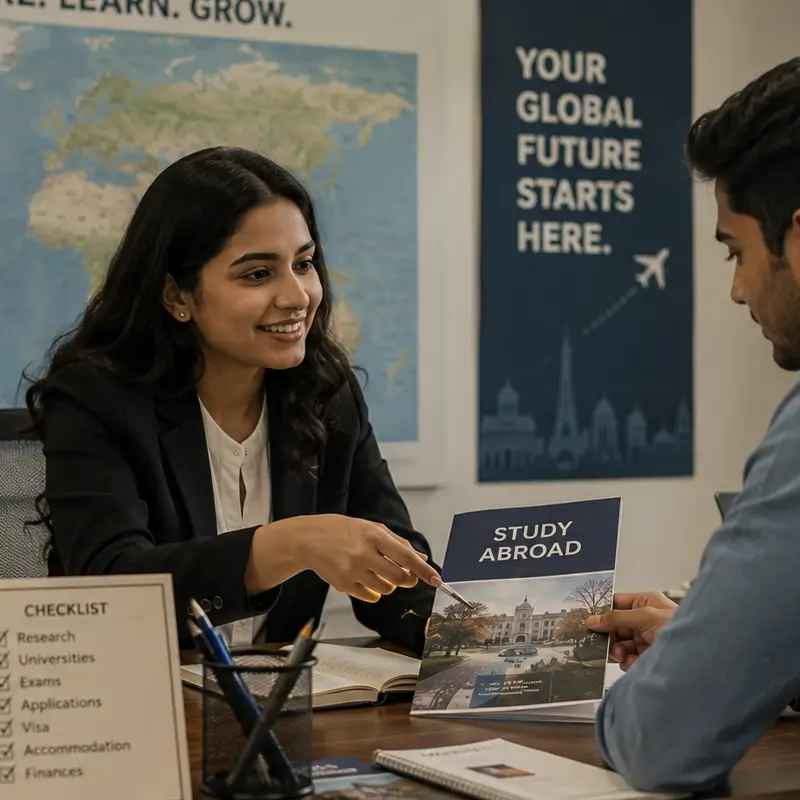
Once students identify the pathway that best aligns with their goals, careful planning becomes essential. The process begins with researching universities and programs that match their academic interests rather than simply choosing institutions based on rankings or popularity. They should understand admission requirements, prepare for language proficiency or standardised tests where applicable, build strong application materials, and create a realistic financial plan that accounts for tuition, living expenses, travel, and available scholarships.
Seeking guidance from mentors, faculty members, alumni, or trusted study abroad consultants in India can also help students navigate the application and visa process more confidently. Ultimately, successful study abroad planning is less about following a checklist and more about making informed decisions that align with one's academic aspirations, career ambitions, and personal growth.
Studying abroad is no longer simply about earning a degree from a foreign university. It is about choosing experiences that broaden perspectives, strengthen critical thinking, and prepare students for a world where careers increasingly transcend borders. Whether through a full-time degree, an exchange program for Indian students, or short-term global learning opportunities, the value of international education lies in the knowledge, adaptability, and global mindset students develop along the way.
At the same time, the decision to study abroad should be driven by purpose rather than popularity. The right destination, university, or program is not necessarily the one with the highest ranking or the lowest cost, but the one that aligns with your academic interests, career aspirations, and learning style. Atlas Skilltech University helps in careful planning, financial preparedness, and a clear understanding of your long-term goals can make the journey both meaningful and rewarding.
As higher education continues to evolve, students who combine strong academic foundations with global exposure will be better equipped to navigate uncertainty, collaborate across cultures, and lead in an interconnected world. The journey begins not with choosing a country, but with choosing the kind of learner and professional you aspire to become.
Students can study abroad after Class 12 by applying for undergraduate programs, or after graduation by pursuing master's, diploma, or research programs at international universities. The process typically involves researching universities, meeting academic and language proficiency requirements, preparing application documents, securing admission, applying for a student visa, and arranging finances. Students can also seek guidance from experienced study abroad consultants in India to better understand admissions, documentation, and visa procedures.
The cost of studying abroad varies depending on the country, university, course, and lifestyle. On average, tuition fees can range from ₹8 lakh to ₹40 lakh or more per year, while living expenses may range from ₹6 lakh to ₹15 lakh annually. Students should also budget for visa fees, health insurance, travel, accommodation, and study materials. Exploring study abroad scholarships for Indian students, education loans, and university grants can significantly reduce the overall financial burden.
The right destination depends on your academic goals, career plans, and budget. However, Germany, France, Italy, Poland, and Hungary are often considered among the cheapest countries to study abroad for Indian students due to their relatively lower tuition fees and scholarship opportunities. Countries such as the United States, the United Kingdom, Canada, and Australia remain popular for their globally recognised universities, strong research ecosystems, and career prospects, though they generally involve higher education and living costs.
While requirements differ by country and institution, students generally need academic transcripts, passport, language proficiency test scores (such as IELTS or TOEFL), a Statement of Purpose (SOP), Letters of Recommendation (LORs), proof of financial support, and a valid admission offer from a recognised university. Once admitted, students must apply for a student visa by submitting the required documents, attending a visa interview if applicable, and meeting the destination country's immigration requirements.
Yes. Students do not necessarily need to pursue a full-time degree to gain international exposure. An exchange program for Indian students allows learners to spend a semester or academic year at a partner university while continuing their degree at their home institution. In addition, short-term study abroad opportunities such as summer schools, research collaborations, international workshops, and global immersion programs offer valuable cross-cultural, academic, and industry exposure without requiring a long-term overseas commitment.