


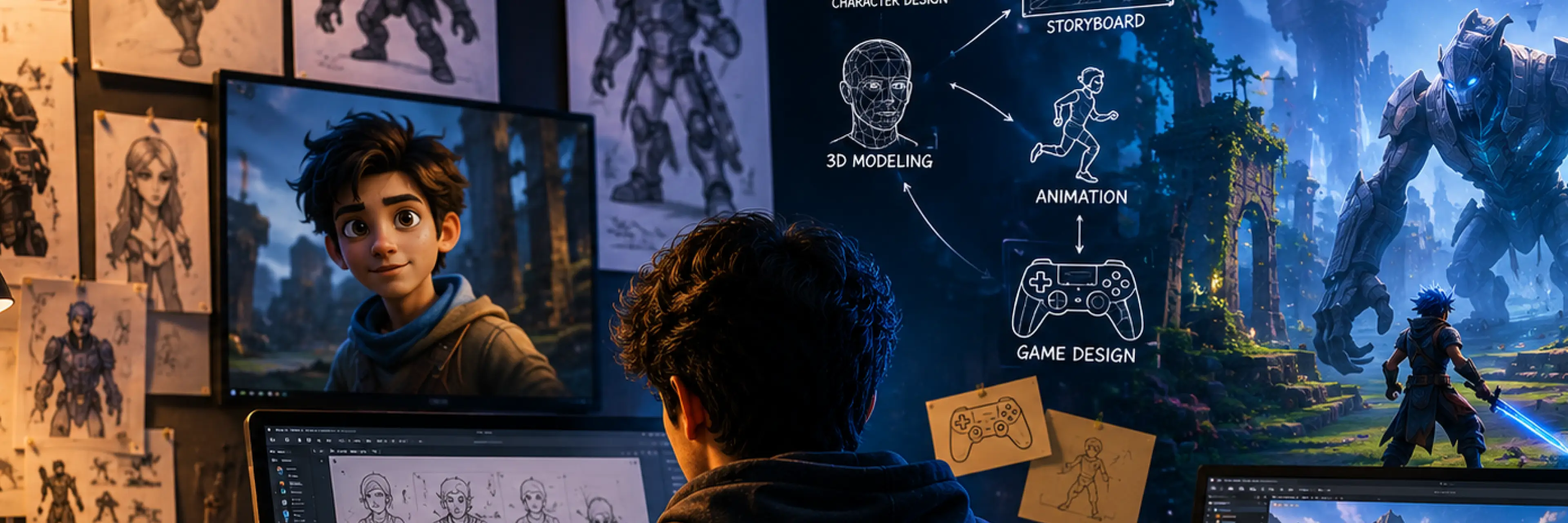
Not long ago, students pursuing animation and visual effects typically imagined careers in films, television, or advertising. Today, those same skills are powering much more than entertainment. From immersive video games and virtual reality experiences to healthcare simulations and interactive learning platforms, the worlds of animation, technology, and design are increasingly overlapping. Think about the digital experiences people engage with every day. The realistic characters in a game, the cinematic visual effects in a virtual environment, and the interactive worlds used for training or education all rely on the same creative foundations: storytelling, character design, motion, world-building, and visual communication. These are precisely the skills students develop through a B.Des Animation and VFX program.
Yet, game design often remains an overlooked career path. While many students enrolling in a bachelor in VFX and animation or pursuing a B Des in Animation envision working in film or media, few realize how naturally their skills translate to game development.
This shift comes at a time when the VFX industry in India and the gaming sector are both experiencing significant growth. As a result, interest in game design courses in India is rising among students who want to combine creativity with technology and build experiences rather than simply create content.
What makes game design particularly exciting is its interdisciplinary nature. It sits at the intersection of animation, storytelling, user experience, psychology, and emerging technologies. For students pursuing a VFX degree or specialized VFX training and character animation degree programs, it offers an opportunity to apply their creative skills in one of the world's fastest-evolving industries.
The question is no longer whether game design is a viable career. It is whether it has become one of the most promising opportunities that animation and VFX students have yet to fully discover.
Animation and visual effects have evolved far beyond their traditional association with cartoons, films, and television. Over the last two decades, rapid advances in technology have transformed these disciplines into essential components of the digital economy. Today, animation and VFX are shaping experiences across video games, augmented and virtual reality, immersive brand campaigns, architectural visualization, product design, healthcare simulations, and even scientific communication. For instance, the same animation techniques used to bring a film character to life can be used to create a virtual training environment for medical professionals or an interactive gaming experience for millions of users worldwide.
This shift has fundamentally changed what employers expect from creative professionals. Technical proficiency alone is no longer enough. Modern creators must understand how people interact with digital experiences, how stories can be told across different platforms, and how emerging technologies can enhance engagement. As a result, a bachelor in VFX and animation today is far more interdisciplinary than it was a decade ago. Students are exposed not only to animation principles and visual effects production but also to design thinking, user experience, interactive media, real-time technologies, and digital innovation.
The growing convergence of entertainment, technology, and design means that graduates are no longer preparing for a single industry. They are preparing for a wide range of opportunities where creativity and technology intersect. In this evolving landscape, the most successful professionals will be those who can adapt their skills across multiple mediums, collaborate with diverse teams, and create experiences that are as interactive as they are visually compelling.
At first glance, animation, visual effects, and game design may seem like distinct career paths. Animation is often associated with films and digital content, VFX with cinematic spectacles, and game design with interactive entertainment. However, the reality is far more interconnected. The skills that power great animated stories and stunning visual effects are increasingly becoming the foundation of modern game development.
As gaming experiences become more cinematic and immersive, studios are actively seeking professionals who can blend artistic creativity with technical expertise. This is why graduates of a B.Des Animation and VFX program often find themselves well-positioned for careers in game design and interactive media.
Memorable games are built around memorable characters. Whether it is a fantasy hero, a sports athlete, or a futuristic avatar, every character must look believable, move naturally, and connect with players emotionally.
The principles taught in a B Des in Animation program, such as anatomy, character development, facial expressions, body language, and movement, are directly applicable to game development. Unlike films, where viewers passively watch a character's journey, games require characters to respond dynamically to player actions. This makes animation expertise even more valuable in creating engaging gameplay experiences.
Successful games are no longer defined solely by gameplay mechanics. Players increasingly expect rich narratives, detailed environments, and worlds that feel alive.
The same storytelling techniques used in animated films and visual media help game designers craft compelling player experiences. From developing a narrative arc to designing environments that communicate a story without words, animation and VFX professionals already possess many of the skills needed to build immersive game worlds. This ability to create emotional engagement through visual storytelling is one of the reasons why animation graduates are finding opportunities beyond traditional media industries.
Visual effects do much more than make games look impressive. They provide feedback, guide player behavior, and enhance immersion.
For example, a burst of light when a player completes a mission, environmental effects during a storm sequence, or realistic explosions during gameplay all contribute to the overall experience. These elements rely on many of the same techniques used by professionals pursuing a VFX degree or advanced VFX training and character animation degree programs.
As gaming technology continues to evolve, demand is growing for artists who understand how to create effects that are both visually striking and technically optimized for real-time environments.
Perhaps the strongest connection between animation, VFX, and game design lies in their shared focus on experience creation. All three disciplines aim to capture attention, evoke emotions, and engage audiences.
However, game design adds another layer: interaction. Designers must think about how users will navigate a world, make decisions, overcome challenges, and stay engaged over time. This requires an understanding of psychology, design thinking, storytelling, and technology.
For students exploring game design courses in India , this interdisciplinary nature makes the field particularly exciting. It offers an opportunity to apply creative skills while collaborating with developers, designers, and technologists to build experiences that are not just watched, but actively lived by users.
As the lines between entertainment, technology, and immersive media continue to blur, the connection between animation, VFX, and game design will only become stronger, creating new possibilities for creative professionals across industries.
Also Read: Animation and Graphic Design Degree: Everything You Need to Know
One of the biggest misconceptions about game design is that it is simply about creating games. In reality, game designers are experienced architects who combine creativity, technology, storytelling, and problem-solving to build engaging digital experiences. This is one reason why students pursuing a B.Des Animation and VFX program are increasingly exploring careers in game development, where their creative and technical skills can be applied in new and exciting ways.
A game designer's role extends far beyond designing characters or visual elements. They create gameplay mechanics, define rules and challenges, shape player journeys, develop narratives, and ensure that every interaction feels intuitive and rewarding. A strong foundation gained through a bachelor in VFX and animation program can be particularly valuable, as these disciplines already emphasize storytelling, visual communication, and user engagement.
Game designers must constantly think from the player's perspective. What keeps someone engaged? How difficult should a challenge be? What motivates a player to continue exploring a world? Answering these questions requires an understanding of human behavior, design thinking, and user experience. This is why many game design courses in India now combine creative education with elements of psychology, technology, and interaction design.
The field is also highly collaborative. Designers work alongside animators, developers, artists, and VFX specialists to create immersive digital worlds. As the VFX industry in India continues to grow and gaming becomes increasingly sophisticated, professionals with a VFX degree or specialized VFX training and character animation degree are finding opportunities that extend well beyond traditional film and media roles.
What makes game design particularly compelling is its growing relevance across industries. The same principles used to create engaging games are now being applied to education platforms, healthcare simulations, corporate training programs, and interactive digital products. For students interested in combining creativity, technology, and innovation, game design represents a career path with both depth and future potential.
When people think about careers in game design, they often picture professionals working at gaming studios, developing the next popular console, mobile, or PC game. While that remains a major career pathway, the reality is that the skills developed through a B.Des Animation and VFX program are increasingly being applied across a wide range of industries. As organizations look for more engaging, interactive, and immersive ways to communicate information and solve problems, professionals with expertise in animation, visual effects, storytelling, and user experience are finding opportunities well beyond entertainment.
The entertainment industry continues to be a major employer for graduates with a bachelor in VFX and animation background. Streaming platforms, film production houses, animation studios, and digital content companies are constantly looking for talent that can create compelling visual experiences. As audiences demand higher-quality content and immersive storytelling, the lines between film, animation, and gaming are becoming increasingly blurred, creating new opportunities for multidisciplinary creators.
Technologies such as Augmented Reality (AR), Virtual Reality (VR), and Mixed Reality (MR) are reshaping how people interact with digital content. These experiences require realistic environments, interactive storytelling, character design, and visual effects, making them a natural extension of the skills gained through a VFX degree . From virtual training environments to immersive retail experiences and digital twins, XR is emerging as one of the most exciting growth areas for creative professionals.
Learning is becoming more interactive, visual, and experience-driven. Educational platforms are increasingly using game mechanics, animation, and immersive content to improve engagement and knowledge retention. Professionals with expertise in game design and animation help create virtual learning environments, gamified educational tools, and interactive content that make complex subjects easier to understand and more engaging for learners.
One of the lesser-known applications of game design and visual storytelling is healthcare. Hospitals, medical institutions, and healthcare technology companies are using animation, simulation, and immersive technologies for training, treatment, and patient education. Whether it is creating realistic surgical simulations, rehabilitation programs, or medical visualizations, professionals with a VFX training and character animation degree can contribute to solutions that have a real-world impact on people's lives.
Organizations are moving away from traditional training methods and adopting interactive learning experiences that improve engagement and retention. Game design principles are increasingly being used to create virtual onboarding programs, leadership simulations, compliance training modules, and scenario-based learning experiences. These applications demonstrate how the core principles of game design can be used to solve business challenges and improve learning outcomes.
Today's digital products are expected to be intuitive, engaging, and user-centric. The same understanding of interaction, storytelling, and user behavior that drives successful games is also valuable in product and experience design. Professionals from B Des in Animation and game design backgrounds often contribute to user experience design, interactive installations, digital engagement platforms, and emerging technology products where creativity and usability must work together.
As the VFX industry in India continues to expand and digital experiences become more immersive, the demand for professionals who can blend design, technology, and storytelling will only grow. For students exploring game design courses in India , this means their career prospects are no longer limited to gaming alone. Instead, they have the opportunity to apply their skills across multiple industries that are shaping the future of how people learn, work, communicate, and interact with technology.
Game design is no longer a niche extension of animation or visual effects. It is becoming a central part of how digital experiences are imagined, built, and delivered. From immersive storytelling and interactive learning to healthcare simulations and virtual environments, the same creative foundations that power animation and VFX are now shaping a much wider digital ecosystem.
For students pursuing a B.Des Animation and VFX , this shift opens up a more expansive career landscape than ever before. Skills developed through a bachelor in VFX and animation , whether in storytelling, character design, motion, or visual effects, are no longer limited to film or media. They now translate directly into fields like game design, XR, digital product design, and experience-driven technologies. As the VFX industry in India continues to evolve and game design courses in India gain momentum, the boundary between disciplines is steadily disappearing.
What stands out most is not just the range of opportunities, but the nature of the work itself. These careers are about shaping how people interact with technology and experience digital worlds. That requires a mix of creativity, curiosity, and adaptability that goes beyond traditional specialization.
For students looking to explore this intersection of design, technology, and innovation in a more structured way, institutions like ATLAS ISDI provide an environment where these disciplines come together naturally. It is less about choosing a single path and more about learning how to move across them with confidence and clarity.
Most animation courses after 12th range from 3 to 4 years for a full degree like a B.Des Animation and VFX or related undergraduate programs. Diploma and certificate courses can be shorter, usually between 6 months and 2 years, depending on the depth of training.
Yes. A B.Des Animation and VFX builds strong foundations in storytelling, design, motion, and visual communication. These skills translate well into game design roles, especially in areas like character design, world-building, and interactive storytelling.
Yes, game design is a growing field in India. With the rise of mobile gaming, esports, and interactive media, demand for skilled designers is increasing. Many students are now exploring game design courses in India to enter this space early.
Game design focuses on the creative side—concepts, gameplay mechanics, story, and user experience. Game development focuses on the technical side—coding, engine work, and building the actual software that runs the game.
Yes, the VFX industry in India is growing steadily due to demand from films, OTT platforms, advertising, and gaming. With rising global outsourcing and digital content consumption, opportunities for skilled artists are expanding.
Graduates can explore careers in animation studios, VFX production, gaming companies, XR/AR/VR development, advertising, digital media, and interactive design. Roles range from animator and VFX artist to game designer, motion designer, and experience designer.