



B Des Interior design in India is at an interesting crossroads. On one hand, there is a deep-rooted design language shaped by culture, climate, craft traditions, and lived experiences. On the other, there is a fast-moving, tech-driven ecosystem that is redefining how spaces are conceived and delivered. The gap between these two worlds is narrowing quickly, and education is where this shift becomes most visible.
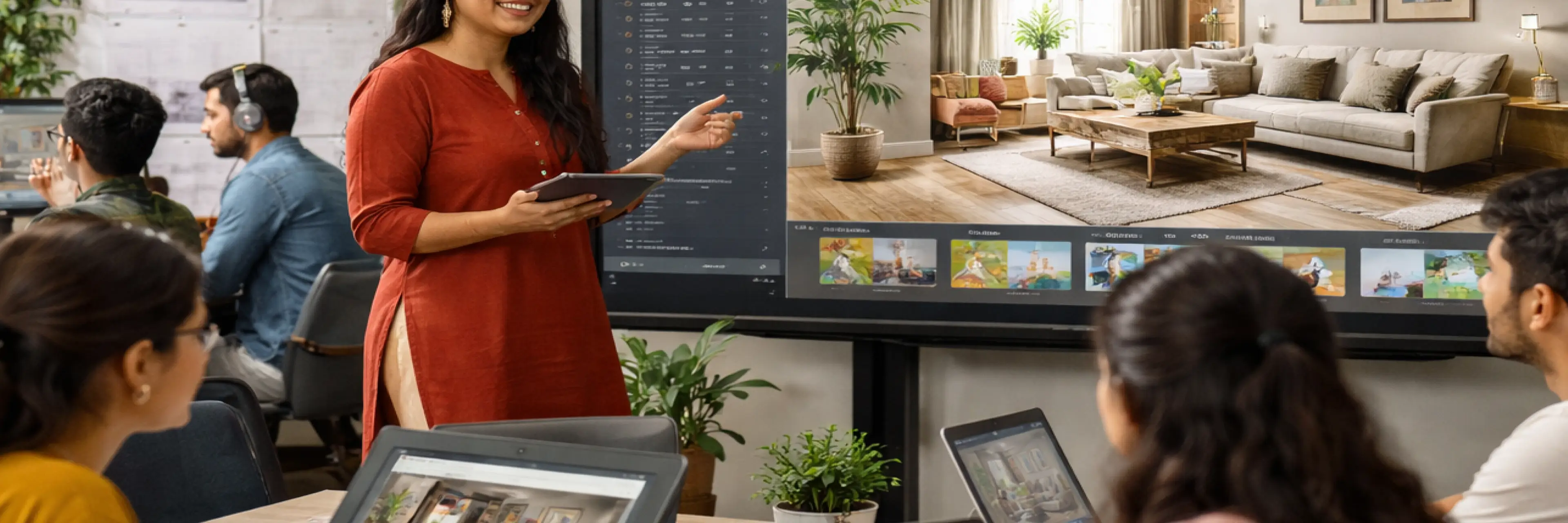
Walk into any contemporary design studio today, and you will notice something subtle but significant. The process is no longer linear. Designers are not moving step by step from concept to execution in the way they once did. Ideas are being generated, tested, visualised, and refined almost simultaneously. This is where AI in interior design begins to quietly reshape the discipline.
Artificial intelligence is not just speeding things up. It is changing how designers think. It introduces a new layer between imagination and outcome, where data, prediction, and automation begin to influence creative decisions. For students pursuing a B Des Interior Design or a bachelor of interior design degree , this changes the nature of learning itself. They are not just being trained to design spaces. They are being trained to design with systems that can think, suggest, and adapt.
This shift brings both opportunity and responsibility. While AI interior design opens up new ways to explore form, function, and user experience, it also demands a deeper understanding of context, ethics, and human behaviour. A tool can generate a layout, but it cannot fully grasp the cultural nuance of an Indian home, the emotional value of space, or the social dynamics that shape how interiors are used. So the real question is not whether AI should be part of interior design education . That answer is already clear. The more important question is how thoughtfully it is being integrated into the learning journey, and whether students are being prepared to engage with it critically rather than passively.
In 2025, a forward-looking interior design degree is not just about mastering aesthetics or technical skills. It is about understanding how technology, especially interior design using AI , is redefining the role of the designer. And more importantly, how designers can retain their human lens in an increasingly intelligent, automated world.
A future-facing B Des Interior Design program can no longer treat AI as an optional layer. It has to be woven into how students think, experiment, and solve problems from day one. The shift is not about adding a software class. It is about redesigning the learning experience itself.
At a foundational level, students need to understand how interior design using AI actually works. This goes beyond learning interfaces or commands. It requires a conceptual grasp of what sits behind the tool.
Without this layer of understanding, there is a real risk of passive designing. Students may accept outputs at face value instead of questioning them, refining them, or pushing them further.
At the same time, theory alone is not enough. A strong bachelor of interior design degree must ensure consistent, hands-on engagement with evolving interior design AI tools that are already shaping professional workflows.
This kind of exposure helps students build fluency, not just familiarity. They learn how to move between tools, compare outputs, and integrate them into a coherent design process.
But the most important shift is philosophical. The goal of an interior design degree is not to produce software operators who rely on automation. It is to develop designers who can think independently while working alongside intelligent systems.
When done right, AI does not reduce the role of the designer. It sharpens it. It pushes students to be more intentional, more analytical, and more aware of the impact their decisions have. That is what will define the next generation emerging from interior design schools in India. Not just their ability to use tools, but their ability to think beyond them.
There is a growing concern in design education that AI might flatten creativity. The fear is simple. If every student has access to the same tools, templates, and generative systems, will the outcomes start to look similar? It is a fair question, especially in a field like interior design where originality, intuition, and personal expression have always mattered deeply.
In practice, though, something different is unfolding. AI is not narrowing creativity. It is expanding the entry points into it. For students working within a B Des Interior Design or a bachelor of interior design degree , AI becomes less about producing final answers and more about opening up possibilities that would have been difficult to explore otherwise. Ideas that once required hours of manual iteration can now be tested in minutes. Complex spatial configurations, unconventional material combinations, and unexpected lighting scenarios can be visualised early in the process, allowing students to explore directions they might not have considered at all.
What changes is not the presence of creativity, but the way it is exercised. The emphasis shifts from effort spent on execution to clarity of thought and intent. In an environment shaped by AI in interior design , the quality of output depends less on technical skill alone and more on how well a student can frame a problem, guide the tool, and interpret what comes back. A vague input produces a generic result. A thoughtful, well-contextualised prompt can lead to surprising and meaningful directions.
This turns interior design using AI into a continuous dialogue rather than a one-way process. The student is no longer simply drawing or modelling in isolation. They are interacting with a system that responds, challenges, and sometimes even disrupts their expectations. The creative act becomes iterative, layered, and more reflective. Instead of committing to a single idea too early, students are encouraged to explore multiple versions, compare outcomes, and refine based on reasoning rather than habit.
Far from making design uniform, this actually increases variation in thinking. The real differentiator becomes not the tool itself, but how each designer uses it. Two students can work with the same interior design AI tools and arrive at entirely different outcomes based on their understanding, sensitivity, and ability to make decisions. This is where creativity shifts from execution to direction, from producing form to shaping meaning.
In this sense, AI is not replacing originality. It is testing it. And for students learning within an interior design degree , that pressure can be a powerful catalyst for deeper, more intentional design thinking.
There is a quiet but important shift happening in how interior design is being understood. For a long time, design decisions were guided largely by intuition, observation, and experience. Those elements are still central, but they are no longer the only reference points. With AI entering the picture, especially in AI in interior design , data has started to play a more active role in shaping how spaces are imagined and evaluated. This does not reduce creativity. It adds a new layer of responsibility to it.
Interior spaces are no longer judged only by how they look in renders or how visually striking they appear in presentations. There is a growing focus on how a space behaves once it is occupied. This includes circulation patterns, spatial efficiency, energy usage, acoustic comfort, and even emotional response over time. For students pursuing a bachelor of interior design , this shift changes the way they are trained to think. A design is no longer considered complete when it looks good. It is considered successful when it works well in real conditions. AI tools make this easier to test by simulating usage patterns and predicting how people might move through or interact with a space before it is built.
The introduction of interior design AI tools allows students to move beyond static assumptions. Instead of relying only on sketches or fixed plans, they can now work with dynamic simulations that respond to variables like lighting, occupancy, or function. A retail space, for example, can be analysed for how customers are likely to navigate it, where they might pause, and how that affects engagement. An office layout can be tested for productivity flow, collaboration zones, or privacy needs. This does not replace the designer's judgment. It gives it more context. The role of the student shifts from simply creating layouts to interpreting patterns and making informed design decisions based on what the data reveals.
As data becomes more integrated into interior design education , design decisions naturally become more accountable. It is no longer enough to say a space feels right. There is now a need to understand why it works, who it works for, and what evidence supports those choices. This adds depth to the learning process. For students in an interior design degree , it creates a balance between instinct and analysis. They are still encouraged to trust their design intuition, but they are also trained to question it, test it, and refine it using measurable insights. Over time, this builds a more grounded design mindset, where creativity and evidence work together rather than in opposition.
What is emerging is not a replacement of traditional design thinking, but an evolution of it. AI is simply accelerating a shift that was already beginning in interior design education in India, where performance, experience, and human behaviour are becoming as important as form and aesthetics.
For students exploring a bachelor of interior design degree in 2025, the expectations around what makes a strong designer have clearly shifted. Earlier, a portfolio filled with polished visuals and well-rendered spaces was often enough to stand out. Today, that is only one part of the story. The industry is looking for designers who can think, adapt, and respond to change as quickly as the tools they use evolve.
What matters now is not just what a student designs, but how they arrive at those designs. The thinking behind the work carries as much weight as the final output. With the growing influence of AI in interior design , students are expected to show comfort with experimentation, clarity in decision-making, and the ability to move between creative intuition and digital tools with ease.
In practical terms, this means the portfolio itself is evolving. It is no longer a static showcase of finished projects. It is becoming a record of process, exploration, and refinement. The ability to demonstrate how an idea changes over time, and why certain decisions were made, is becoming just as important as the final visual.
For students preparing for a career in this field, a few shifts are becoming clear:
Alongside these expectations, the choice of interior design schools plays a much more critical role than before. Institutions that actively integrate technology into studio learning, expose students to real-world briefs, and encourage experimentation with interior design using AI are better positioned to prepare graduates for what comes next. The difference is no longer just in curriculum names, but in how learning actually happens inside the classroom.
Ultimately, a strong interior design degree today is less about mastering a fixed set of skills and more about building the ability to evolve with the field itself. The designers who will stand out are the ones who are comfortable learning continuously, questioning their own process, and using technology not as a shortcut, but as an extension of their thinking.
Interior design is no longer evolving in a straight line. It is shifting through layers of technology, behaviour, and new ways of thinking about space. AI has entered this landscape not as a replacement for designers, but as a force that is reshaping how design decisions are made, tested, and refined. For students pursuing a B Des Interior Design or a broader interior design degree , this means the foundation of learning is expanding. It is no longer only about form, proportion, and aesthetics. It is also about understanding systems, interpreting data, and working with tools that can generate and simulate ideas at scale.
What remains unchanged is the human core of design. Spaces still exist for people. They still need emotion, context, and cultural grounding. AI can suggest possibilities, but it cannot fully understand lived experience. That responsibility continues to sit with the designer. The difference now is that designers have more inputs, more speed, and more ways to test their thinking than ever before.
The future of interior design education in India will belong to those who can hold both sides together. The precision of technology and the sensitivity of human insight. The efficiency of tools and the depth of thought behind them. This balance is what will define meaningful, relevant, and lasting design work in the years ahead.
For students who want to be part of this shift, the learning environment matters as much as curiosity. Institutions that encourage experimentation, integrate real-world tools like interior design AI tools , and push students to think beyond convention will shape the next generation of designers.
ATLAS SkillTech University, through ISDI, brings this future-focused approach into design education, where creativity meets technology and ideas are tested in real-world contexts. It is a space where students are not just learning interior design, but learning how to evolve with it.
AI is used to generate layouts, suggest material palettes, optimise space planning, and create realistic visualisations faster than traditional methods. It also helps designers test multiple design possibilities in less time.
AI will not replace interior designers. It will change how they work by handling repetitive tasks and generating options, while designers focus on creativity, context, and decision-making. Human judgment remains central to meaningful design.
Students should explore tools that support space planning, 3D visualisation, generative design, and rendering. These tools help speed up ideation and improve design accuracy during projects.
Yes, many modern programs are beginning to include AI in their curriculum. Students are introduced to digital tools that support design thinking, visualization, and real-time simulation as part of their learning.
AI changes the process by making it more iterative and data-informed. Designers can quickly test ideas, refine layouts, and evaluate performance before final execution, making the workflow more efficient and exploratory.