
In November 2024, a team of 15 undergraduate students from Mumbai made history. They became the first and only team from India to qualify for NASA's Human Exploration Rover Challenge in the Remote Controlled division. Out of all the universities and institutions across the globe, only three teams were selected for that category. One of them was from ATLAS SkillTech University. This is not just a feel-good achievement story. It is a case study in what happens when higher education stops treating learning as passive and starts treating it as action. It is a mirror held up to an industry still asking: what does a BTech education actually prepare students for?
Before understanding what ATLAS students accomplished, it helps to understand what NASA HERC actually demands.
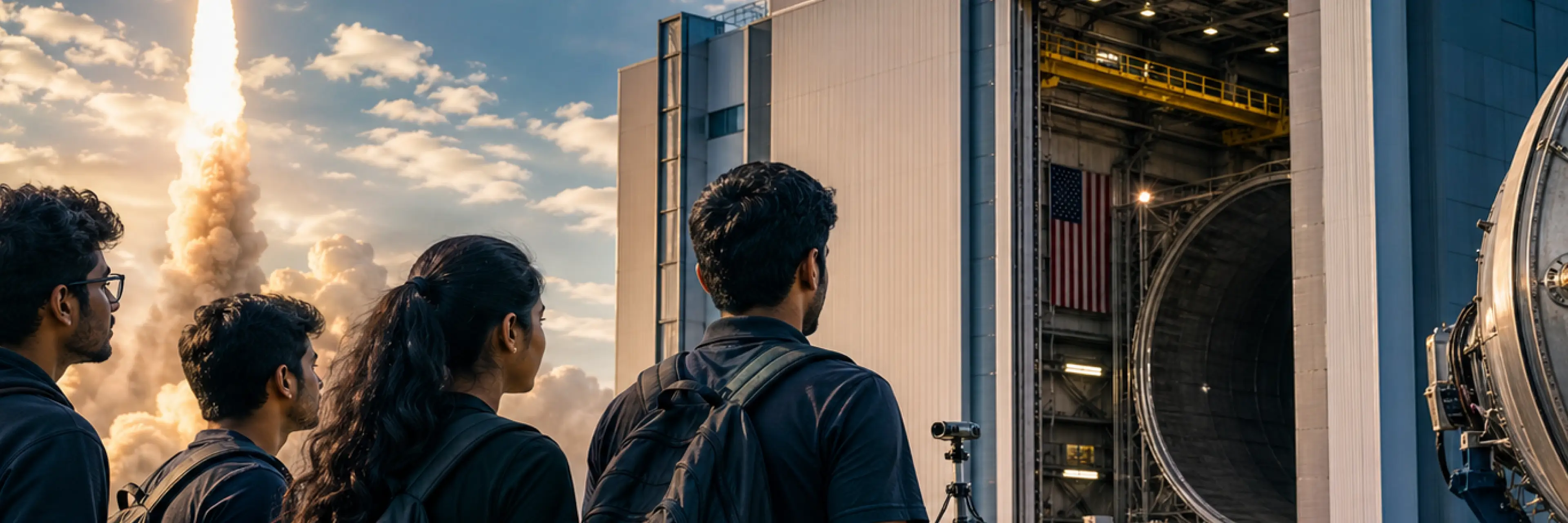
NASA's Human Exploration Rover Challenge is one of the space agency's longest-running student engineering programs. It is a nine-month challenge. Teams design, build, test, and then compete with a rover, either human-powered or remote-controlled, on terrain engineered to simulate the surface of the Moon or Mars. The final event is held at the U.S. Space & Rocket Center in Huntsville, Alabama, near NASA's Marshall Space Flight Center.
HERC is not a hackathon. It is not a two-day sprint. It demands sustained design thinking, iterative engineering, project management, cross-functional teamwork, safety documentation, and community outreach, all at once, across the better part of an academic year.
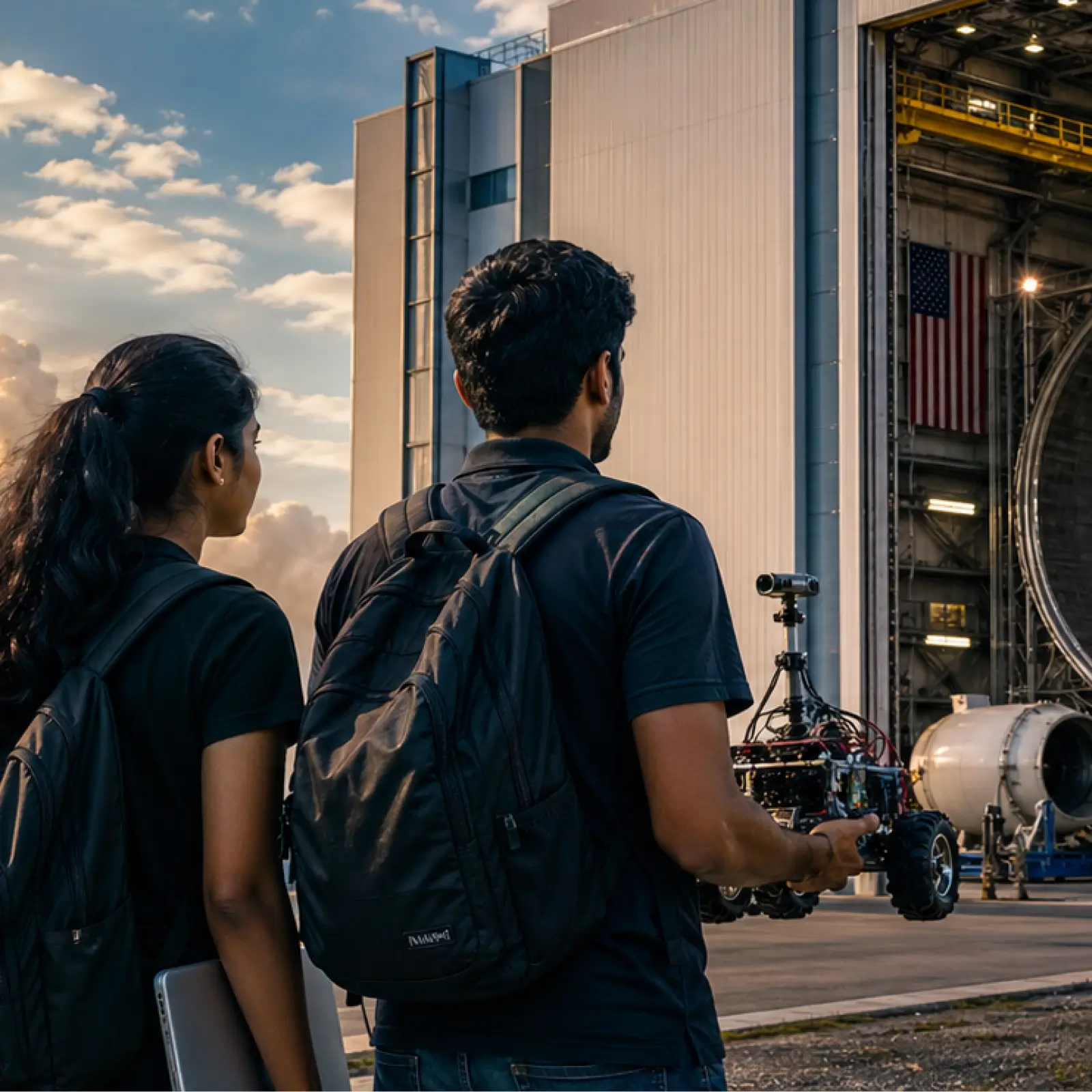
The competition asks students to navigate craters, rocks, and steep inclines. Teams must collect simulated scientific samples and manoeuvre through constrained spaces, all while operating their rover remotely. Every system, mechanical, electrical, software, must work in harmony under real-world pressure.
When ATLAS uGDX, School of Technology received confirmation that their team had been selected for NASA HERC 2025, the milestone was immediate and unmistakable: they were India's first. No other university in the country had secured a place in the RC division of this challenge. Of all institutions globally, only three teams were chosen for the Remote Controlled college/university division. ATLAS SkillTech University was one of them.
This matters beyond the pride it carries. It signals something structural. It tells us that students from a relatively young institution in Mumbai, not from a storied IIT, not from a globally ranked research university could compete at the same level as teams from around the world. What they had was not legacy. What they had was preparation of a different kind.
The ATLAS team named their rover Mushak, after the vehicle of Lord Ganesha. The name reflects a quiet confidence. Ganesha's Mushak is small, nimble, and capable of navigating the most complex terrain. So was the rover they built.
There is a common misconception about BTech project-based learning. Many universities treat it as an add-on, a final-year capstone or a semester elective layered on top of conventional coursework. The ATLAS approach treats it as the spine of the academic experience.
The NASA HERC journey demonstrates what that looks like when executed seriously.
Planning came before fabrication. The team did not pick up tools and start building. They drafted timelines, mapped departmental dependencies, defined milestones, and worked backward from competition deadlines. This discipline , planning as an engineering act, not a bureaucratic exercise, is something most graduates only encounter years into their careers.
Iteration replaced perfectionism. The team's engineering philosophy centred on testing over assumptions. Real-world trials exposed weaknesses. Failures were documented and analysed. Every setback became data. The rover evolved because the team was willing to be wrong, learn fast, and improve. Most curricula reward getting the right answer on the first attempt. This approach rewards something harder and more valuable: the ability to recover intelligently from the wrong one.
Safety was designed in, not added on. Electrical systems were built with layered protection. Software extended into control logic and safeguard mechanisms. Safety protocols were established before fabrication began. For undergraduates, this level of systems thinking is remarkable, and it is precisely what industry demands.
Communication was treated as an engineering skill. NASA HERC evaluates teams not just on rover performance, but on outreach, documentation, and community engagement. Team Mushak ran STEM workshops and demonstrations, making their process visible to younger students and communities. Explaining complex systems to others, as the team discovered, is one of the most rigorous ways to test your own understanding.
This is the full picture of hands-on engineering learning. Not just building something, but building it accountably, communicating it clearly, and standing behind it publicly.
A question worth asking: what did ATLAS provide that made this possible?
Access matters. The university's Makers Lab and 3D printing infrastructure gave students the physical tools to prototype rapidly. The ability to fabricate, test, fail, and rebuild quickly is not something students can do within a conventional lab schedule. The ATLAS environment was built for exactly this kind of velocity.
Mentorship matters. Professor Shashikant Deepak guided the team through not just the technical challenges but the administrative and logistical ones as well. The team visited labs across India during their development phase. The university facilitated that travel without treating it as an exception to the educational process. It was the educational process.
Institutional belief matters. Siddharth Shahani, Co-founder and Executive President of ATLAS SkillTech University, described the students' achievement as evidence of their leadership and commitment to innovation in STEM. When leadership publicly attributes success to student initiative, rather than crediting the institution first, it signals a particular culture. One where students are principal actors, not passive recipients.
India's space ambitions are accelerating. ISRO's recent milestones have captured global attention. The Chandrayaan missions repositioned India as a serious player in lunar exploration. The country's private space sector is emerging rapidly, with startups building launch vehicles, satellite systems, and propulsion technologies at a pace that was unimaginable a decade ago. International aerospace industries are increasingly looking at Indian talent to fill roles that did not exist five years ago.
But ambition at the national level only translates into outcomes when it is matched by preparation at the individual level. That is where institutions come in.
For students pursuing B Tech aeronautical engineering or any aerospace-adjacent discipline, the gap between academic training and industry readiness has long been a frustration. Most programs teach the theory of flight, propulsion, and structures, but rarely place students inside a project where those principles must hold up under real constraints, real deadlines, and real scrutiny.
The ATLAS HERC teams, in 2025 and in their return for NASA HERC 2026, are part of a generation closing that gap through action. They are not waiting for an opportunity to arrive. They are building credibility through demonstrated performance on one of the world's most respected student engineering platforms. That credibility is not theoretical. It is documented, internationally evaluated, and publicly recognised by NASA itself.
More than 500 students from 75 teams worldwide participated in HERC 2025. To be among them as the only Indian team in the Remote Controlled division is to occupy a place in global space education that India had not claimed before. It also sets a precedent. The next generation of Indian students interested in aerospace, space systems, and deep-tech engineering now has a reference point, proof that the path from a Mumbai classroom to a NASA competition stage is not only possible but has already been walked. That is the kind of signal that changes what students believe is available to them.
There is a version of higher education that is primarily about credentials. Attend, complete, graduate, present the document. It is a transaction. The institution provides a degree and the student provides years of their life. What gets built in the process is often secondary to what gets certified.
There is another version that is primarily about capability. Engage, struggle, build, demonstrate what you can do. This version is harder to design, harder to sustain, and significantly harder to evaluate. But it produces something the first version rarely does: graduates who have already been tested.
The ATLAS SkillTech University HERC story is unambiguously an example of the second version.
Fifteen students from Mumbai named their rover after a mythological vehicle known for navigating impossible terrain. Then they built it. Then they took it to Huntsville, Alabama, and competed against teams from across the world. Then they came back, reflected on what did not work, rebuilt their systems, and returned for a second campaign with sharper engineering and stronger outreach.
That arc matters. It is not a single moment of inspiration. It is a cycle of ambition, execution, failure, learning, and return. That cycle is what professional engineering actually looks like. And these students experienced it before they graduated.
The question worth sitting with, for students weighing BTech admission options and for institutions designing programs, is a simple one: what does your education produce that you can point to? Not a syllabus. Not a ranking. Not a list of courses completed. Something built. Something tested. Something that went somewhere and did something under conditions that could not be controlled.
That is what education can look like. That is what BTech project-based learning at its most serious produces. And that is the standard ATLAS has set, not for itself alone, but for Indian engineering education as a whole. The question now is who rises to meet it.
Yes. A 15-member team from ATLAS uGDX, School of Technology became the first and only team from India to qualify for NASA HERC in the Remote Controlled division. Only three teams globally were selected for that category, and ATLAS SkillTech University was one of them. The team competed at the U.S. Space & Rocket Center in Huntsville, Alabama, and returned for NASA HERC 2026 as well.
NASA HERC is a nine-month student engineering competition where teams design and build rovers to navigate simulated lunar terrain. The final event is held in Huntsville, Alabama, and is open to students globally. Teams are evaluated on rover performance, safety documentation, and community outreach. For students in B Tech aeronautical engineering and related fields, it is one of the most rigorous real-world engineering challenges available at the undergraduate level.
Team Mushak built a remote-controlled rover capable of navigating rocks, craters, and steep inclines while completing mission tasks like collecting scientific samples. Named after Lord Ganesha's vehicle, the rover was developed using ATLAS's Makers Lab and 3D printing tools, under the mentorship of Professor Shashikant Deepak. Electrical, software, and safety systems were all engineered from the ground up.
ATLAS uGDX made history as the only Indian university selected for the Remote Controlled division of NASA HERC 2025, one of just three teams globally in that category. The team also earned recognition in the STEM Engagement category, and returned for NASA HERC 2026 where they received awards in Social Media and Community STEM Engagement.
NASA HERC gives BTech students hands-on experience building and defending a real engineering system under genuine pressure. Across one nine-month cycle, students develop skills in mechanical design, electrical systems, software, project management, and communication. For students evaluating BTech admission options, this kind of experiential learning is direct evidence of graduate readiness — something a syllabus alone cannot demonstrate.