


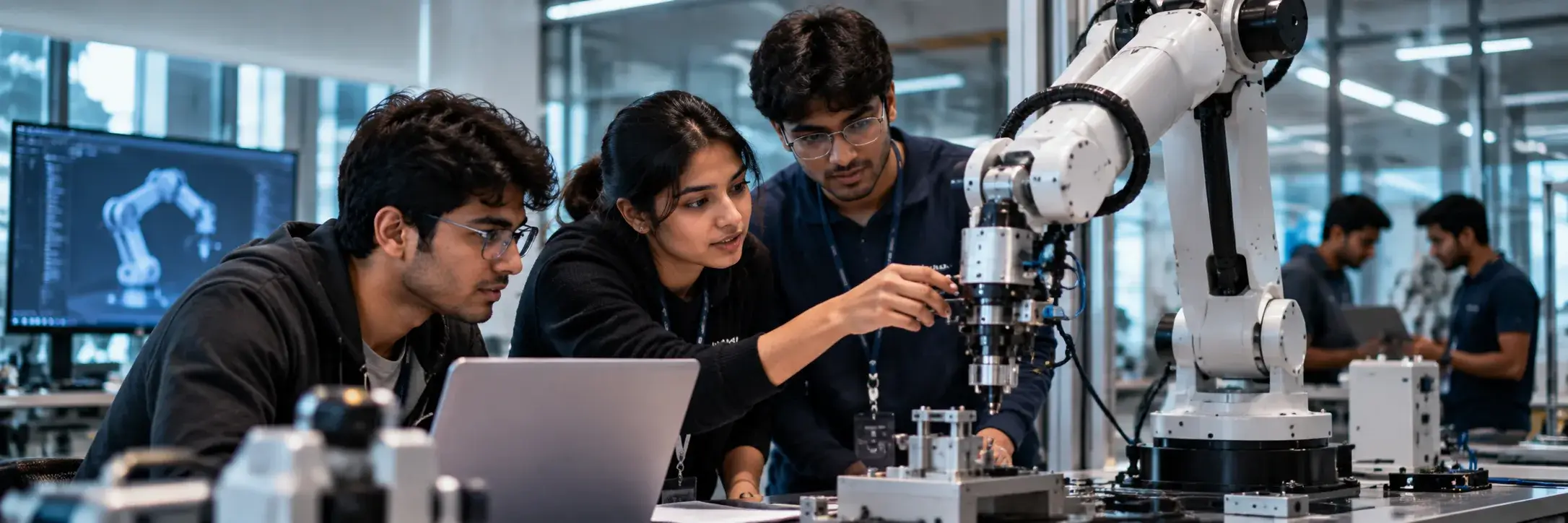
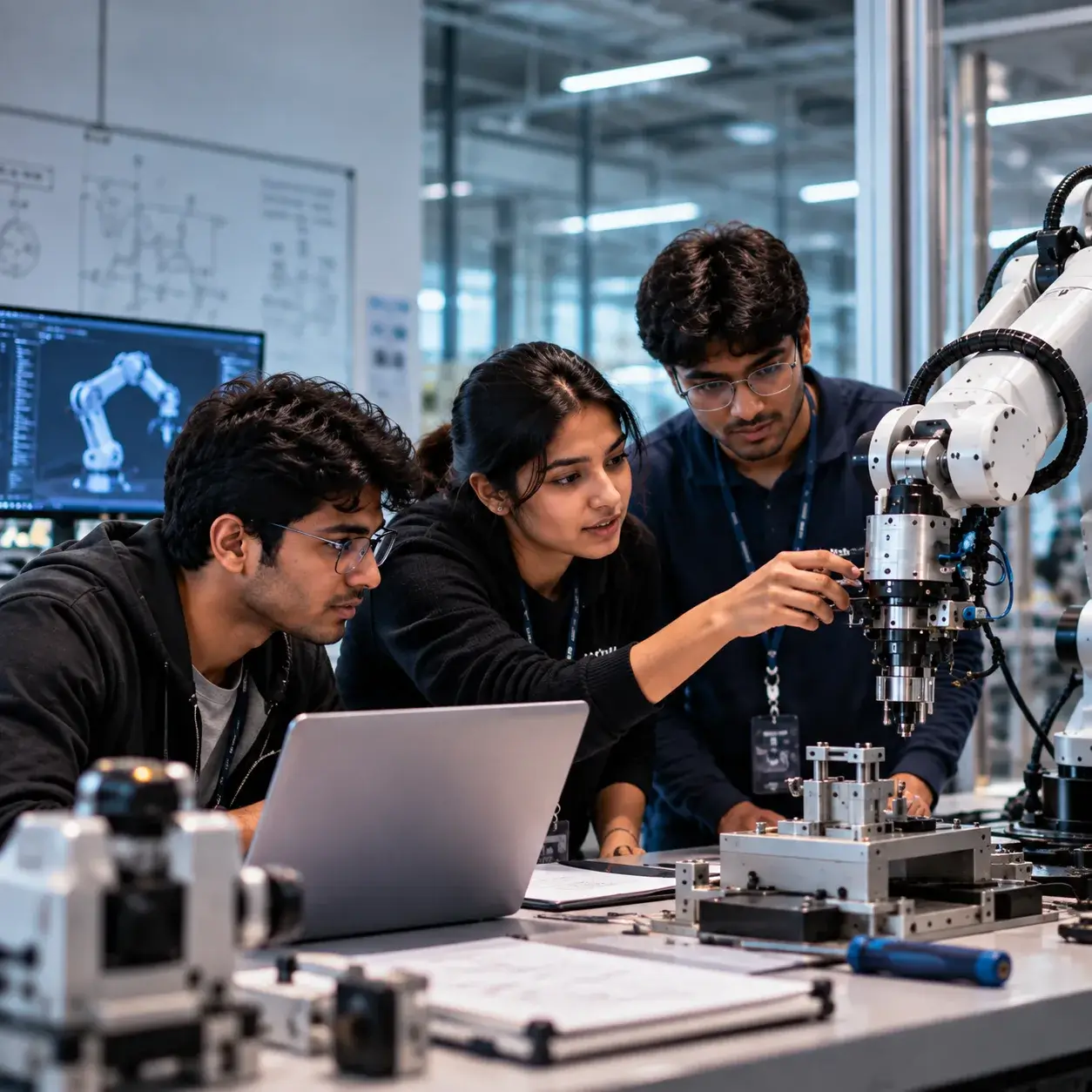
Industry 4.0 is often described as the next industrial revolution. And it is—but calling it a revolution alone makes the transition sound more sudden than it really is.
India's industrial landscape is changing through two forces working simultaneously. There is the revolution : robotics, artificial intelligence, industrial IoT, computer vision and autonomous systems are introducing capabilities that were difficult to imagine a decade ago. At the same time, there is an evolution : existing factories, machines, processes and workforces are gradually adapting to these technologies rather than being replaced overnight.
A manufacturing line does not necessarily become a smart factory because a robot is added to it. It becomes smarter when machines can generate and share data, systems can respond to changing conditions, and engineers can connect physical processes with software and intelligence. In many cases, this transformation happens one process, machine or decision at a time.
That distinction is particularly important for BTech students. The future of engineering will not simply be about knowing how to build a robot or programme an automated system. It will increasingly involve understanding how mechanical systems, electronics, software, AI, data and human expertise work together.
This is already visible in India's growing adoption of industrial robotics and advanced manufacturing technologies. For students considering B.Tech in Robotics Engineering , B.Tech Robotics and Automation , or B.Tech Robotics and Artificial Intelligence , the opportunity therefore goes beyond learning a specialised technology. It is about developing the ability to understand and solve problems in an industrial ecosystem that is becoming increasingly connected, intelligent and interdisciplinary.
The more useful question, then, is not whether robots will define the future. It is what kind of engineer will be needed to design, integrate and improve the systems in which those robots operate.
Robotics is becoming one of the most important bridges between the digital and physical worlds. While AI can analyse information and software can make decisions, robotics enables those decisions to translate into physical action. This makes B.Tech in Robotics increasingly relevant to the broader Industry 4.0 ecosystem, where machines are expected to sense their environment, process information and respond with greater precision and autonomy. In India, this shift is already visible in manufacturing.
According to the International Federation of Robotics, India installed around 9,120 industrial robots in 2024, with automotive manufacturing accounting for 45% of installations. The growth, however, should not be interpreted as a simple move towards fully automated factories. India's industrial landscape is diverse, and automation is often being introduced incrementally, through robotic arms, automated inspection, connected machinery, predictive maintenance and digitally monitored production lines. This is where the evolution of robotics becomes as important as the revolution.
Modern robotic systems increasingly combine sensors, computer vision, AI, embedded systems, control engineering and industrial software, moving beyond repetitive task execution towards more adaptive and intelligent operations. For students exploring B.Tech Robotics and Automation or B.Tech Robotics and Artificial Intelligence , this convergence is particularly significant. The opportunity lies not merely in learning how to programme a robot, but in understanding how robotics fits into larger systems, from smart factories and warehouses to automotive, electronics and pharmaceutical manufacturing.
As India's industries become more connected, engineers who can bridge mechanical systems with computation, intelligence and automation will increasingly be working at the centre of this transformation.
Robotics is emerging as one of the key technologies shaping India's Industry 4.0 transition because it brings together the physical and digital sides of engineering. A robot can execute a physical task, but modern robotic systems can also sense their surroundings, process information and respond to changing conditions. This is making robotics increasingly relevant across manufacturing, logistics, automotive, electronics and other technology-intensive sectors.
For students considering B.Tech in Robotics , this means understanding the larger technology ecosystem around a robot.
This convergence is also expanding the scope of B.Tech Robotics and Automation and B.Tech Robotics and Artificial Intelligence . Students are no longer preparing only to build or programme individual machines; they are learning to understand how hardware, software, data and intelligent systems interact. The result is a field where mechanical engineering, electronics, computer science and AI increasingly overlap and where the ability to connect these disciplines can be as valuable as expertise in any one of them.
The impact of Industry 4.0 becomes clearer when we look at where these technologies are being deployed. Different industries are adopting robotics and automation for different reasons—some to improve precision, others to increase production capacity, strengthen quality control or manage increasingly complex manufacturing processes. For students pursuing B.Tech in Robotics or exploring B.Tech Robotics and Automation , understanding these sector-specific applications can provide a clearer picture of where their skills may be applied.
The automotive sector has been one of the strongest adopters of industrial robotics in India. Robots are used across welding, painting, assembly, material handling and inspection, particularly where processes demand consistency and precision.
The shift towards electric vehicles is also changing the nature of automotive manufacturing. Battery systems, electronics, sensors and software are becoming increasingly important components of the vehicle ecosystem. This creates opportunities for engineers who can work across robotics, automation, embedded systems, electronics and AI rather than focusing on mechanical production alone.
Pharmaceutical manufacturing presents a different use case for robotics. Here, automation is closely linked to accuracy, hygiene, consistency and quality control.
Robotic systems can support packaging, material handling, inspection and other repetitive processes in controlled manufacturing environments. For students pursuing B.Tech Robotics and Artificial Intelligence , this sector also demonstrates how robotics can intersect with computer vision, data systems and intelligent quality-control processes.
Electronics manufacturing requires high levels of precision, particularly as components become smaller and production volumes increase. Automated assembly, inspection and material handling can help manufacturers maintain consistency while scaling production.
This is creating demand for engineers who understand robotics alongside electronics, embedded systems, computer vision and industrial automation. A robotics BTech graduate with exposure to these interconnected areas can therefore find applications beyond conventional factory-floor robotics.
These sectors illustrate an important characteristic of Industry 4.0: the same technology can solve very different problems depending on the industry. A robot used for automotive welding requires a different combination of skills from a vision-based inspection system used in electronics or an automated handling system used in pharmaceuticals.
For students, this makes industry exposure and multidisciplinary learning increasingly valuable. The goal is not simply to learn how a technology works, but to understand why a particular industry needs it and how engineers can adapt it to solve real operational problems.
As Industry 4.0 develops, career opportunities for B.Tech Robotics graduates are expanding beyond the traditional role of a robotics engineer. The convergence of robotics with AI, IoT, computer vision, embedded systems and industrial automation is creating roles that sit across multiple engineering disciplines. This also means that students do not necessarily have to follow one fixed career path after completing a robotics BTech programme. Their opportunities can vary depending on whether they develop deeper expertise in software, hardware, automation, intelligent systems or industrial applications. What matters increasingly is the ability to apply technical knowledge to real-world systems and work across disciplinary boundaries.
Some of the emerging career pathways include:
For students pursuing B.Tech Robotics and Automation or B.Tech Robotics and Artificial Intelligence , the growing overlap between these roles also creates room for specialisation. Building depth in one area while understanding adjacent technologies can help students remain adaptable as Industry 4.0 continues to evolve.
Whether a B.Tech in Robotics is a good career choice depends less on the degree title and more on the skills and problems a student wants to work on. Robotics now intersects with AI, computer vision, embedded systems, automation and autonomous technologies, creating career paths well beyond traditional robotics engineering. This also makes the question which engineering branch is best for future more nuanced. A student can specialise in robotics software, industrial automation, AI, computer vision, embedded systems or R&D depending on their interests.
Salary varies significantly by role, experience, location and specialisation. Broad market estimates in India include:
These are indicative ranges rather than guaranteed outcomes. Current salary data also varies across platforms and sample sizes. The more important factor is the depth of skills a graduate develops. Combining robotics with AI, computer vision, controls, embedded systems or industrial data can open different career pathways and influence long-term progression.
India’s manufacturing expansion is being supported by industrial investment and initiatives such as the Production Linked Incentive (PLI) schemes, covering sectors including electronics, pharmaceuticals, automobiles, IT hardware and advanced batteries. By December 2025, the government reported more than ₹2.16 lakh crore in cumulative PLI investments. While this does not directly translate into robotics jobs, greater manufacturing capacity can increase demand for automation, precision, process optimisation and intelligent production systems.
For students pursuing B.Tech in Robotics , B.Tech Robotics and Artificial Intelligence or B.Tech Robotics and Automation , the opportunity lies in developing skills that solve real industrial problems. That could mean combining programming and electronics with AI, computer vision, sensors or automation. A project that uses computer vision to detect manufacturing defects, for example, demonstrates a more practical understanding of Industry 4.0 than simply building a moving robot. Ultimately, strong engineering fundamentals, hands-on projects and interdisciplinary thinking can be more valuable than specialising in a technology in isolation.
India’s Industry 4.0 journey is not simply about adding more robots to factories. It is about creating systems where machines, software, data and people can work together more intelligently. As this transition continues, robotics will increasingly intersect with AI, automation, electronics, computer science and other engineering disciplines.
For BTech students, this creates a future where adaptability matters alongside technical depth. The engineers who understand how technologies connect, experiment with real-world applications and approach problems from multiple perspectives will be better equipped to contribute to this evolving industrial landscape. B.Tech in Robotics , B.Tech Robotics and Automation and B.Tech Robotics and Artificial Intelligence can each provide pathways into this ecosystem, but the larger opportunity lies in developing the ability to keep learning as the technology evolves.
Industry 4.0, after all, is not a destination. It is an ongoing process of revolution and evolution and the engineers entering the workforce today will help shape what comes next.
Industry 4.0 refers to the integration of robotics, AI, IoT, data and automation to create more connected and intelligent industrial systems. Robotics provides the physical capability to act on data and automated decisions.
Automotive, electronics, pharmaceuticals, logistics and advanced manufacturing are among the key sectors adopting robotics and Industry 4.0 technologies.
Graduates can explore roles such as robotics engineer, automation engineer, robotics programmer, systems integrator, computer vision engineer, embedded systems engineer and Industrial IoT engineer.
Entry-level robotics and automation roles can typically offer around ₹3–6 LPA, while experienced and specialised professionals can earn ₹6–25+ LPA, depending on skills, experience, location and employer.
It can be a relevant choice for students interested in intelligent manufacturing, automation and robotics. Its value can be strengthened by developing complementary skills in AI, computer vision, programming, electronics and industrial systems.