


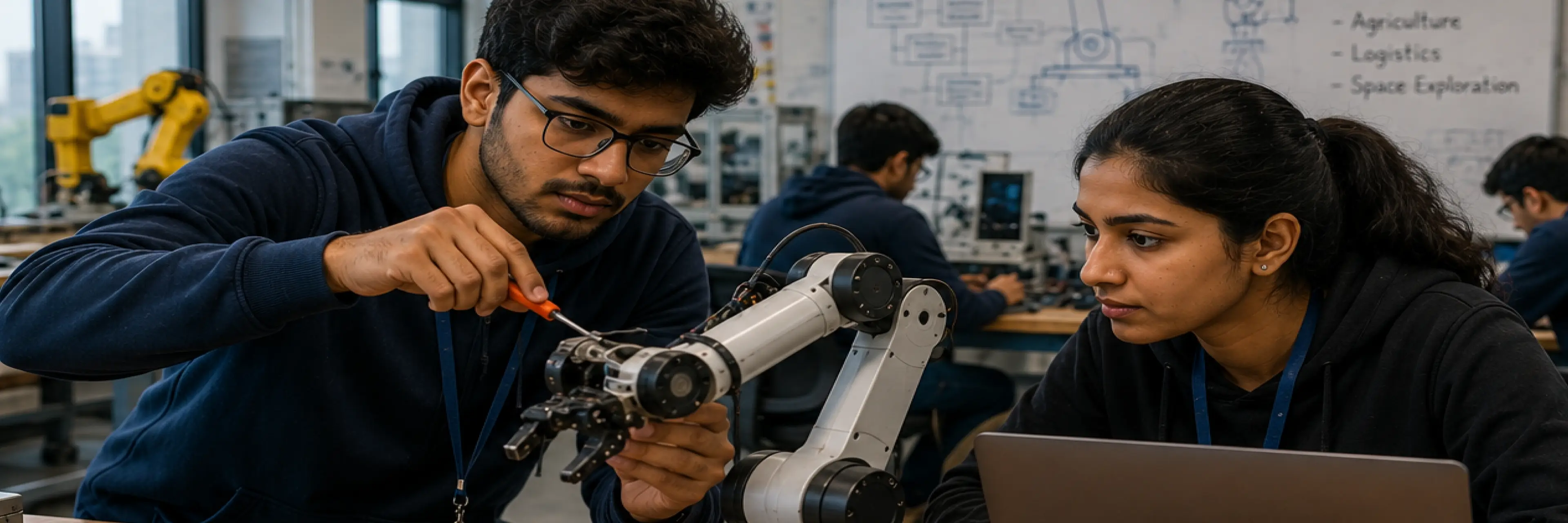
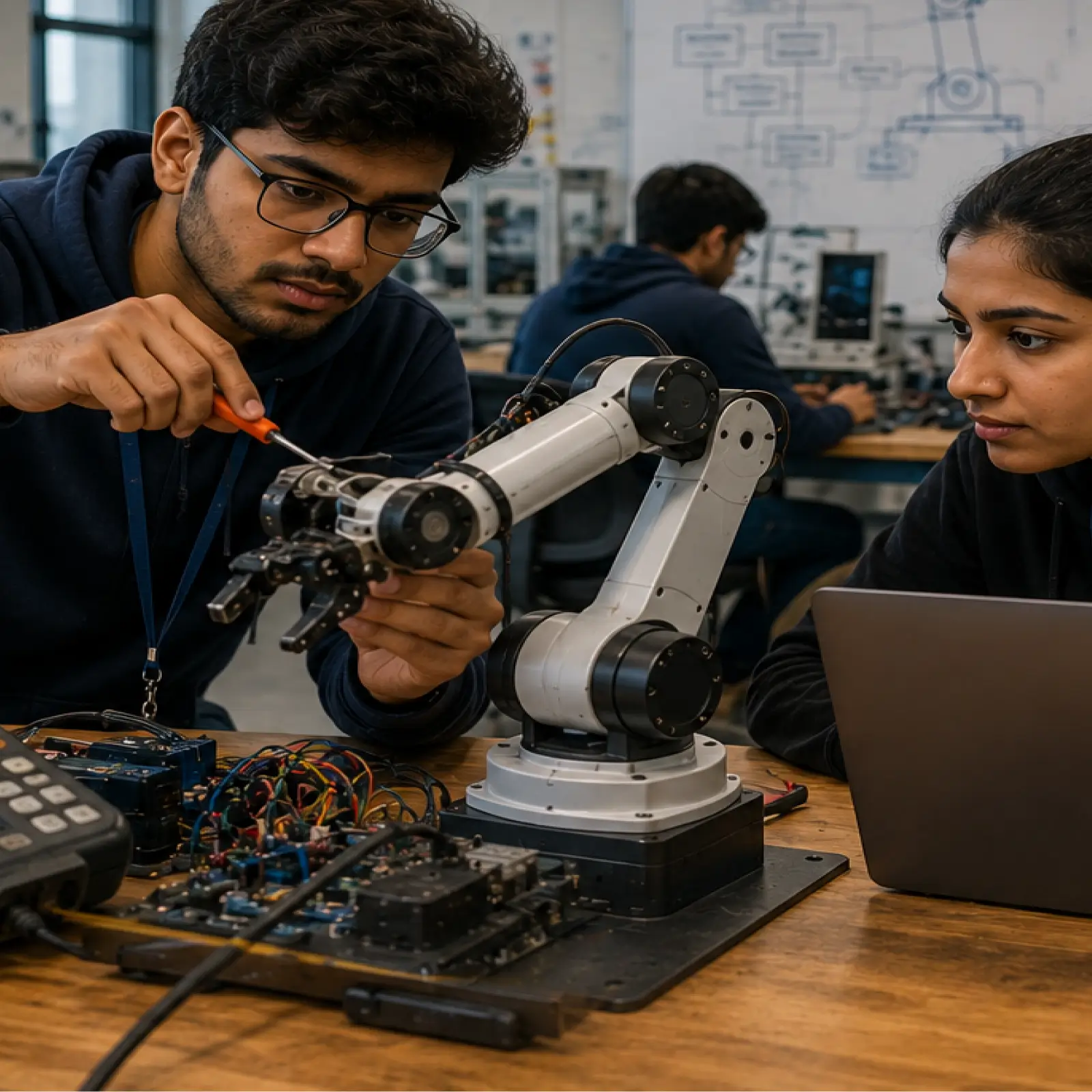
Engineering is entering a new era. The biggest innovations today are no longer being built within the boundaries of a single discipline. They are emerging at the intersection of intelligence, automation, data, and human-machine interaction.
Think about the technologies shaping everyday life. Autonomous vehicles make decisions in real time. Smart factories predict errors before they happen. Hospitals use robotic-assisted surgeries for precision. Warehouses run on automated systems that can process thousands of operations with minimal human intervention. Even agriculture is becoming increasingly driven by intelligent machines and predictive technologies. What connects all of these advancements is one thing: the growing role of robotics and automation.
For years, robotics was viewed as a highly specialized field associated mainly with manufacturing units or research labs. Today, that perception is rapidly changing. Automation is becoming deeply embedded across industries, not as an optional upgrade, but as a necessity for efficiency, scalability, accuracy, and innovation. At the same time, Artificial Intelligence has completely transformed the capabilities of robotic systems. Machines are no longer limited to repetitive actions. They can now analyse data, adapt to environments, recognise patterns, and make decisions with increasing accuracy. This convergence of AI, automation, and robotics is redefining how industries operate and how future technologies are built.
The shift is also changing the nature of engineering itself. Traditional engineering education often functioned in silos, where mechanical, electronics, and computer science existed as separate pathways. But modern technological systems rarely work that way. Building intelligent products today requires interdisciplinary thinking. Engineers are expected to understand how software interacts with hardware, how data drives automation, and how intelligent systems function in real-world environments.
This is why emerging fields like BTech Robotics and Automation, BTech in Robotics , and BTech Robotics and Artificial Intelligence are gaining attention among students looking toward future-focused careers. The growing interest in BTech in Robotics Engineering and BTech in AI and Robotics reflects a larger industry shift. Companies are no longer looking only for engineers with isolated technical expertise. They are looking for professionals who can work across systems, technologies, and evolving digital ecosystems.
As industries continue moving toward intelligent automation, the question is no longer whether robotics is relevant. The real question is how deeply it will shape the future of engineering, business, healthcare, mobility, infrastructure, and innovation itself.
For years, robotics was seen as a highly specialized field associated mainly with industrial manufacturing, research labs, or futuristic innovation. It was often viewed as a niche area within engineering with limited real-world application. That perception has changed rapidly. Today, robotics and automation are becoming central to how industries operate, innovate, and scale. From healthcare and logistics to agriculture, mobility, retail, and smart infrastructure, intelligent automation is transforming the way businesses function.
The reason is simple: industries are moving toward faster, smarter, and more efficient systems. Businesses today need technologies that can improve productivity, reduce errors, optimize operations, and handle large-scale processes with precision. Robotics, combined with Artificial Intelligence and machine learning, is helping industries achieve exactly that. This is why robotics is no longer limited to factory automation.
Robotic-assisted surgeries are improving medical precision. Warehouses now use autonomous systems to manage inventory and streamline supply chains. Agriculture is adopting automated monitoring and harvesting technologies, while smart cities are integrating intelligent systems into traffic and infrastructure management.
What makes this field especially relevant is its interdisciplinary nature. Modern robotics combines multiple technologies, including:
A self-driving vehicle, for example, is not built through one engineering discipline alone. It relies on automation systems, AI-powered decision-making, sensors, and real-time data processing working together simultaneously.
This shift is also changing engineering education itself. Students today are increasingly drawn toward future-focused domains that combine innovation, technology, and real-world application. As a result, programs like BTech Robotics and Automation , BTech in Robotics , and BTech Robotics and Artificial Intelligence are gaining significant attention. The rising interest in BTech in Robotics Engineering and BTech in AI and Robotics also reflects changing industry expectations. Employers are looking for engineers who can work across technologies, build intelligent systems, and adapt to rapidly evolving digital ecosystems. As automation and AI continue to reshape industries, robotics is no longer a fringe discipline. It is becoming one of the key forces shaping the future of engineering and technological innovation.
One of the biggest strengths of a BTech Robotics and Automation program is its interdisciplinary learning approach. Unlike traditional engineering pathways that focus heavily on a single domain, robotics education combines multiple technologies that work together to build intelligent systems. The goal is not just to teach students how machines function, but to help them understand how automation, data, software, electronics, and AI interact in real-world environments.
A modern BTech Robotics and Automation syllabus typically blends concepts from mechanical engineering, electronics, computer science, automation, and Artificial Intelligence. Students are introduced to areas such as programming, embedded systems, machine learning, sensors, control systems, computer vision, IoT, and robotics design. This integrated academic structure prepares students to work on technologies that require both hardware and software expertise.
However, the learning experience in BTech Automation and Robotics extends far beyond classroom theory.
Since robotics is a highly application-driven field, practical exposure becomes a critical part of the curriculum. Students often work in robotics labs, participate in live projects, build prototypes, and engage in hands-on experimentation to understand how intelligent systems operate in real-world conditions. Industry internships, hackathons, innovation challenges, and collaborative projects also play an important role in helping students develop practical problem-solving abilities.
What makes this field particularly future-focused is the kind of skills students develop throughout the program. Along with technical expertise, students learn:
As industries increasingly move toward intelligent automation, these skills are becoming just as valuable as technical knowledge itself. This is why robotics education is not simply about learning how to build machines. It is about preparing students to work in environments where technology, intelligence, and innovation constantly evolve together.
One of the biggest misconceptions around BTech Robotics and Automation is that it leads to a narrow or highly specialized career path. In reality, the field is expanding rapidly as industries across the world adopt intelligent automation, AI-driven systems, and smart technologies. Today, robotics is no longer limited to manufacturing units or research facilities. Companies across healthcare, logistics, automotive, retail, aerospace, agriculture, and infrastructure are investing heavily in automation and intelligent systems to improve efficiency, scalability, and innovation.
This growing demand is creating opportunities for graduates from BTech in Robotics , BTech Robotics Engineering , and BTech Robotics and Artificial Intelligence programs across multiple sectors.
Students pursuing BTech in Robotics Engineering or BTech in AI and Robotics can explore roles such as:
The scope is also expanding globally as industries move toward Industry 4.0, smart manufacturing, and AI-powered automation ecosystems.
Also Read : Top companies hiring BTech Robotics graduates in India
The demand for robotics and automation professionals is growing across sectors such as:
This increasing adoption of automation technologies is one of the biggest reasons why robotics BTech programs are gaining relevance in future-focused engineering education.
Another major advantage of the field is its innovation and startup potential. Robotics sits at the intersection of AI, automation, sustainability, and smart infrastructure, making it a strong space for entrepreneurship. Startups today are building solutions in:
For students pursuing BTech Automation and Robotics , the opportunities are not limited to traditional employment alone. The field also opens pathways into research, product innovation, deep-tech startups, and emerging technology ventures. As automation continues reshaping industries globally, robotics is increasingly becoming less of a niche career path and more of a future-ready engineering domain with wide-ranging applications.
Also Read: BTech in Robotics in India 2026: Industries, Companies and Why They're Growing
While the growth of automation and intelligent technologies has made robotics one of the most promising engineering domains, it is also important to look beyond the excitement and industry buzz. Like every emerging field, robotics comes with its own challenges, learning curve, and expectations. Students considering BTech Robotics and Automation should understand both the opportunities and the demands of the field before making a career decision.
While robotics is one of the most exciting emerging fields, it is also academically intensive. Students are expected to work across multiple domains such as programming, electronics, AI, automation, and mechanical systems. Success in this field requires consistency, analytical thinking, and a strong willingness to experiment and learn continuously.
The robotics industry is evolving rapidly with constant advancements in AI, machine learning, automation, and smart technologies. Students pursuing BTech in Robotics Engineering need to stay adaptable and open to continuous upskilling. The ability to solve real-world problems and work across interdisciplinary systems is becoming increasingly valuable.
Programs like BTech Robotics and Artificial Intelligence and BTech in AI and Robotics offer strong future potential, but they should not be chosen purely because they are trending. Students who genuinely enjoy innovation, technology, intelligent systems, and hands-on problem-solving are more likely to thrive in this evolving field.
The rise of intelligent technologies is not just changing industries. It is also reshaping the role of universities and the way engineering education is delivered. Traditional learning models built around theoretical instruction and siloed disciplines are no longer enough for fields driven by rapid technological evolution. Areas like BTech Robotics and Automation, BTech Robotics Engineering , and BTech in AI and Robotics require students to work across domains, solve real-world problems, and adapt to constantly evolving technologies.
This is why future-focused universities are moving toward more interdisciplinary and experiential learning models. Engineering education today needs to go beyond classrooms and textbooks by integrating industry exposure, live projects, innovation labs, research opportunities, startup ecosystems, and hands-on experimentation into the learning experience. Students pursuing BTech Robotics and Artificial Intelligence or BTech in Robotics Engineering benefit significantly from environments where they can build prototypes, collaborate across disciplines, and work on real-world applications of automation and intelligent systems.
Industry collaboration is becoming equally important. As automation technologies evolve rapidly, universities must ensure students are exposed to current tools, emerging technologies, and practical industry challenges. The goal is no longer just to create graduates with theoretical knowledge, but to develop future-ready engineers who can innovate, think critically, and contribute meaningfully to technology-driven industries.
Also Read : BTech in Artificial Intelligence After 12th Without Coding
The future of engineering is becoming increasingly intelligent, connected, and interdisciplinary. Robotics and automation are no longer confined to futuristic concepts or niche industrial applications. They are actively shaping how industries operate, innovate, and solve real-world challenges across healthcare, mobility, manufacturing, infrastructure, and beyond.
This is exactly why fields like BTech Robotics and Automation , BTech Robotics and Artificial Intelligence , and BTech in Robotics Engineering are gaining long-term relevance. They reflect a larger shift in engineering itself, where the ability to work across technologies, understand intelligent systems, and adapt to emerging innovations is becoming essential.
At the same time, robotics is not a field students should choose simply because it is trending. It demands curiosity, problem-solving ability, adaptability, and a genuine interest in how technology can interact with the real world. For students who enjoy innovation, experimentation, and interdisciplinary learning, it offers the opportunity to work at the center of some of the most transformative technologies of the future.
As engineering education continues to evolve, universities also play a critical role in shaping future-ready talent. Learning environments that combine industry exposure, experiential learning, innovation, and emerging technologies will become increasingly important in preparing students for the next generation of careers.
At institutions like ATLAS SkillTech University, this future-focused approach is reflected through initiatives like UGDX , which encourage interdisciplinary thinking, industry integration, and hands-on learning experiences designed around the realities of tomorrow's technology landscape.
Yes, BTech Robotics and Automation is emerging as a strong career option in India due to the rapid growth of AI, automation, smart manufacturing, and Industry 4.0 technologies. Industries such as healthcare, automotive, logistics, manufacturing, and infrastructure are increasingly adopting intelligent systems and automation tools. As a result, the demand for professionals skilled in robotics, AI, embedded systems, and automation is steadily growing across both startups and large enterprises.
Earlier, robotics engineering was considered a niche field limited mainly to industrial automation and research. Today, it is becoming increasingly mainstream as automation expands across industries. Programs like BTech in Robotics Engineering and BTech Robotics and Artificial Intelligence are gaining relevance because companies now require engineers who can work with AI-driven systems, automation technologies, and smart machines. While the field is still evolving in India, its applications are growing rapidly across sectors.
Traditional mechanical engineering focuses primarily on machines, manufacturing systems, thermodynamics, and mechanical design. In contrast, BTech Robotics Engineering combines mechanical concepts with Artificial Intelligence, automation, programming, electronics, embedded systems, and machine learning. Robotics is more interdisciplinary and focuses on building intelligent systems capable of automation, real-time decision-making, and human-machine interaction.
Graduates from BTech Robotics and Automation programs can work across multiple industries in India. These include manufacturing and industrial automation, automotive and autonomous mobility, healthcare and medical technology, logistics and warehouse automation, aerospace and defence, agritech and smart farming, and consumer technology and IoT. They may work in roles such as Robotics Engineer, Automation Engineer, AI Systems Developer, Embedded Systems Engineer, or Industrial Automation Specialist.
The scope of robotics in Indian manufacturing is growing significantly as industries move toward smart factories and automation-driven operations. Robotics is being used to improve productivity, reduce operational errors, optimize workflows, and enhance workplace safety. Sectors such as automotive, electronics, pharmaceuticals, and heavy manufacturing are increasingly investing in automation technologies. This growing adoption is creating strong demand for professionals with expertise in BTech Automation and Robotics and intelligent manufacturing systems.