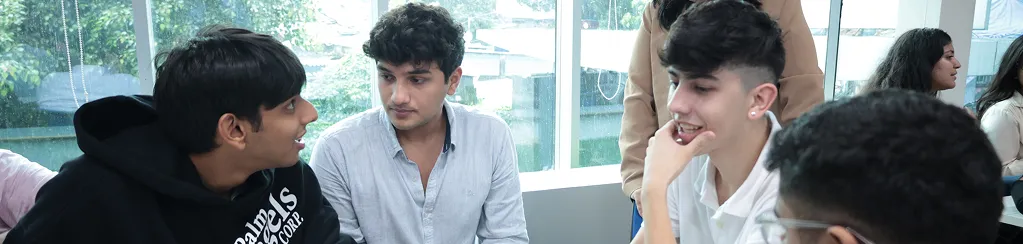


A classroom assignment usually comes with a clear problem, a fixed syllabus, and a predictable outcome. A hackathon offers none of these. Teams receive an open-ended challenge, a strict deadline, and very little certainty about what will work. Within 24 or 36 hours, they must understand a problem, design a solution, write working code, and convince a panel of judges that the idea matters.
This is precisely why hackathons have become such an important part of a B.Tech in Computer Science journey. They compress the entire product development cycle into a single, intense experience. Students research, prototype, test, fail, fix, and present, often without sleep and always under pressure.
For students pursuing a BTech CSE degree, this experience fills a gap that lectures alone cannot. Knowing how a sorting algorithm works is different from deciding which data structure will keep an app responsive when hundreds of users log in at once. Understanding neural networks is different from deploying a model that actually answers a user's question.
Mumbai has a particularly active ecosystem for this kind of learning. The city brings together engineering colleges, startups, financial institutions, media companies and global technology firms. A hackathon in Mumbai may involve a fintech problem statement from a bank, a sustainability challenge from a research centre, or an AI brief from a technology sponsor. Each one offers students a glimpse of how computer science is applied beyond the classroom.
This guide explores why hackathons matter, which events are worth watching in 2026, how to prepare, what recruiters actually notice, and how hackathon experience can shape a student's career.
A hackathon is not simply a coding competition. Coding competitions usually test speed and accuracy against defined problems. Hackathons test something broader: the ability to identify a real problem, build something useful, and explain why it matters.
That distinction is important. Most industry work does not begin with a perfectly defined question. It begins with an ambiguous need. A product manager might say users are abandoning a checkout page. A hospital might want faster access to patient records. Engineers have to translate these concerns into technical decisions.
Hackathons give students an early, low-risk environment to practise this translation.
A B.Tech in Computer Science builds strong foundations in programming, data structures, databases, networks, and operating systems. Hackathons give these concepts a purpose. Students quickly discover why database design matters, why API documentation saves time, and why clean code is easier to debug at 3 AM.
Teams rarely have time to build everything they imagine. They must decide what the minimum viable version looks like. This forces students to separate essential features from nice-to-have ideas, a skill that matters in every engineering role and one that a typical B Tech in Computer Science exam rarely tests.
Most hackathon teams combine developers, designers, and sometimes business-minded members. Students learn to divide work, communicate progress, resolve disagreements, and integrate code written by different people.
Many hackathons are themed around generative AI, agentic AI, Web3, cybersecurity or climate technology. Students pursuing a bachelor of computer science artificial intelligence specialisation, for instance, can test their skills on applied AI problems long before their final-year project.
A certificate shows that a student has studied a subject. A working prototype, a public code repository and a recorded demo show what the student can actually build. This evidence becomes valuable when applying for internships, research opportunities, or startup roles. For anyone still choosing a bachelor for computer science , it is worth asking how much room a programme leaves for this kind of building.
Hackathons are not a replacement for a rigorous computer science bachelor degree . They work best as a complement to it. The degree builds depth. Hackathons test how well that depth can be applied in unfamiliar, time-bound situations.
Also Read: BTech in Cybersecurity Scope in India: Is This the Decade's
Mumbai's hackathon calendar is broad, and no two events reward the same things. It ranges from large, sponsor-backed AI events to intercollegiate competitions hosted by engineering colleges and student developer communities. Some events are open to everyone, while others are limited to undergraduates in a specific region. Choosing the right hackathon in Mumbai therefore starts with understanding what each event values.
Hackathon dates, formats, and eligibility change frequently. Students should always confirm details on the official event page or on platforms such as Devfolio, Unstop, and Internshala before planning their schedule.
The following events and formats are worth tracking for engineering students.
MumbaiHacks has grown into one of the most visible AI hackathons in the country. Its 2024 edition set a Guinness World Record as the largest generative AI hackathon. The 2025 edition, held at NESCO in Mumbai, focused on agentic AI and drew more than 3,500 participants.
The event typically begins with an online qualifying round, followed by an in-person finale in Mumbai. Tracks have included fintech, healthcare, and other industry themes, often shaped by corporate sponsors.
Best suited for: Students interested in AI, machine learning, product building, and startup ecosystems, especially those pursuing a bachelor of computer science artificial intelligence specialisation.
Smart India Hackathon is a national initiative where students solve problem statements submitted by ministries, government departments, and industry partners. Many Mumbai institutions run internal selection rounds before nominating teams for the national stage.
SIH is valuable because its problems are grounded in public challenges, from governance and agriculture to healthcare and disaster management. Students learn to build for users who may have limited digital access, which is an important lesson in inclusive technology. It is also a natural extension of the systems thinking a bachelor of computer science and technology aims to develop.
Best suited for: Teams interested in social impact, public systems and large-scale problem-solving.
Techfest is IIT Bombay's annual science and technology festival, usually held in December. Alongside talks, exhibitions, and robotics events, it hosts several hackathons and technical competitions, often in partnership with technology companies.
Because Techfest attracts participants from across India and abroad, the competition is strong. Even students who do not win gain exposure to high-quality work and a wide network of peers. For students early in a computer science bachelor degree , it is a useful benchmark of where their skills stand.
Best suited for: Students who want to benchmark their skills against strong national competition.
Organised by the IIT Bombay–Honeywell Centre of Excellence for Future Skills and Innovation, this national-level challenge invites undergraduate, postgraduate, and doctoral students to develop scalable solutions for environmental and societal problems.
It suits students who want to connect technology with climate, energy, and resource challenges. It also rewards thinking beyond code, since solutions are expected to show potential as viable ventures.
Best suited for: Students interested in sustainability, IoT, data analytics, and impact-led entrepreneurship.
Mumbai has become an important location for the Ethereum developer community. ETHMumbai combines a hackathon with a conference, while ETHGlobal, a widely recognised organiser of Ethereum hackathons, has announced a Mumbai edition for 2026.
These events are technically demanding. Participants work with smart contracts, decentralised applications and blockchain infrastructure.
Best suited for: Students with an interest in blockchain, cryptography, distributed systems and fintech.
Registrations for Mumbai Builds 2027 opened in October 2026. The event is designed for undergraduate students enrolled in colleges across Mumbai, Thane, Palghar and Raigad. It follows a 36-hour hybrid format that includes an offline round with teams of four members. Inter-college teams are permitted.
Its regional focus makes it a practical hackathon in Mumbai for first-time participants who want to compete alongside peers from across the Mumbai Metropolitan Region.
Best suited for: Undergraduates looking for a structured, region-focused hackathon experience.
Google Developer Groups play a large role in Mumbai's student tech culture. The Build and Grow AI initiative by GDG Cloud Mumbai brings together students and working professionals, with mentors, founders, and senior engineers involved. Previous editions have held their final round at Jio Institute in Navi Mumbai.
GDG on Campus chapters at individual colleges also run their own events, often aligned with this initiative.
Best suited for: Students who want to build with cloud and AI tools while networking with practising engineers, particularly those on a bachelor of computer science artificial intelligence track.
Some of the most accessible opportunities come from engineering colleges across the city. Recent examples include:
These events often have smaller teams, friendlier formats, and mentors who are willing to guide beginners. They are an excellent way to build confidence before attempting larger national events. Many are hosted by institutions often counted among the best colleges for computer science in Mumbai , which also makes them useful places to observe different campus cultures.
Also Read: B.Tech Computer Science: Course Details, Syllabus
Not every hackathon in Mumbai will suit every student. A first-year student, only a few months into a bachelor for computer science , may benefit more from a beginner-friendly college event than from a highly competitive national challenge. A final-year student may prefer sponsor-backed hackathons with direct industry exposure.
Before registering, consider:
The right event is the one that stretches your abilities without overwhelming them. Students comparing the best colleges for computer science in Mumbai can also ask how actively each institution supports hackathon participation.
Many students assume that hackathons reward the best programmers. In practice, they reward the best-prepared teams. Whichever hackathon in Mumbai you choose, preparation begins weeks before the event, not on the first night.
A BTech CSE student does not need to master every technology. However, certain skills make a significant difference under time pressure:
Students in a bachelor of computer science and technology programme often already study many of these subjects. The goal is to practise applying them quickly, ideally by building small personal projects before the event.
Technical strength alone rarely wins. Judges also evaluate clarity, relevance, and feasibility. Students should develop:
A strong hackathon team is balanced rather than identical. Four excellent back-end developers may still struggle to produce a usable interface or a convincing pitch.
A well-rounded team might include:
Roles can overlap, but responsibilities should be clear. Teams should also agree on how decisions will be made before the event begins. Disagreements are inevitable under pressure. A shared process prevents them from becoming conflicts.
Interdisciplinary teams are increasingly common, and many hackathons actively encourage them. A computer science student who has worked alongside designers, management students, or domain experts often brings a broader perspective to a problem. This is one reason many students choosing a bachelor for computer science now look for programmes with cross-disciplinary electives.
A few practical habits can improve both performance and wellbeing:
Winning a hackathon is an achievement. However, when recruiters review BTech CSE candidates, they rarely evaluate the trophy itself. They evaluate what the experience reveals about a candidate.
A student who finishes in the top three but cannot explain their own code leaves a weaker impression than a student who did not win but can clearly walk through their design decisions.
Recruiters want to know what you personally built. Describing your role precisely, for example, "built the recommendation API and integrated it with the front end", is more credible than saying "we built an app".
Interviewers may ask why you chose a particular framework, how you handled data, or what you would change with more time. Students who can discuss trade-offs demonstrate genuine understanding. Hackathons reward exactly the depth a computer science bachelor degree is meant to build.
Hackathons are full of setbacks: failed integrations, broken builds, and last-minute changes. Recruiters value candidates who can describe how they diagnosed and resolved a problem.
Engineering is a team activity. Experience coordinating with teammates, handling disagreements, and presenting to judges signals readiness for professional environments.
A single win can be impressive. A pattern of participation, with projects that improve in quality over time, often says more. It shows curiosity, resilience, and a willingness to learn from failure.
A public GitHub repository, a short demo video, and a concise project write-up allow recruiters to verify claims quickly. For many students pursuing a B Tech in Computer Science , this kind of portfolio becomes as important as academic grades.
In short, recruiters look less for winners and more for builders: people who can take an unclear problem and turn it into something that works. This holds whether a student is enrolled in a bachelor of computer science and technology programme or a specialised AI track.
The value of hackathons depends partly on the learning environment around them. Students benefit most when experimentation, project work and industry exposure are part of everyday education rather than occasional events.
At ATLAS uGDX School of Technology, the technology school of ATLAS SkillTech University, the B.Tech programmes combine core computer science foundations with emerging domains such as artificial intelligence, machine learning, data science, robotics and cybersecurity, making them relevant for students drawn to a bachelor of computer science artificial intelligence pathway.
The B.Tech in Computer Science, AI & ML includes Pinnacle projects that ask students to apply their learning to practical outcomes. Early projects explore areas such as simulation and computer game design, while later ones involve applied data analysis. This structure mirrors the hackathon mindset: define a problem, build a solution, and present the result. It gives a computer science bachelor degree a strong applied dimension.
ATLAS SkillTech University has hosted the Mumbai Hacks Winter Edition 2023 at its campus, bringing together participants from technology and entrepreneurship. It has also organised the ATLAS Hackathon, a nationwide innovation challenge for Class 11 and 12 science students, introducing aspiring technologists to design thinking and problem-solving before they begin a bachelor for computer science .
ATLAS Electives allow students to explore subjects such as design, entrepreneurship, psychology, and fintech across the university. This matters in hackathons, where the strongest teams often combine technical skills with design sensibility and business understanding.
Located in Mumbai's Bandra-Kurla Complex, the campus sits close to a dense network of businesses, startups and technology events. For students, this proximity makes it easier to attend industry talks, meetups and hackathons across the city.
When students compare the best colleges for computer science in Mumbai , it is worth looking beyond rankings. Questions such as how often students build real projects, whether interdisciplinary collaboration is encouraged, and how actively the institution engages with the tech ecosystem can reveal far more about the learning experience.
Hackathon experience does not guarantee a job. Placements depend on many factors, including academic performance, interview preparation, communication, internships, and market demand. However, hackathons can strengthen a candidate's profile in several meaningful ways.
Behavioural interviews often ask candidates to describe a challenge, a conflict, or a failure. Hackathons provide specific, credible examples. A student can explain how their team recovered when an API failed two hours before judging, which is far more convincing than a hypothetical answer.
Most students in a computer science bachelor degree complete similar assignments. Hackathon projects are more distinctive. They show initiative, interests, and the ability to build independently.
Sponsors, mentors, and judges are often engineers, founders, or hiring managers. A strong demo or thoughtful conversation can lead to internship discussions or referrals. Some corporate hackathons, such as Infosys' HackWithInfy, have linked strong performance to interview opportunities.
Some hackathon projects evolve into startups, research work, or long-term open-source contributions. Even when they do not, students learn to think about users, value, and feasibility, which are qualities valued in product-focused roles.
A student may enter a hackathon thinking they enjoy back-end development and leave realising they prefer machine learning or product design. These discoveries can guide elective choices, internships, and career decisions throughout a B Tech in Computer Science .
To translate participation into placement value, students should:
For an engineering student, hackathons are most powerful when they are part of a broader strategy that includes strong fundamentals, internships and continuous learning.
Conclusion
Hackathons mirror how technology work really happens: small teams, tight deadlines, and incomplete information. Mumbai offers no shortage of them, and many of the best colleges for computer science in Mumbai actively host or support these events. The real reward is rarely the prize. It is the confidence of turning an idea into working software.
A bachelor of computer science and technology builds the foundation, and hackathons show what students can build on it. For those exploring a BTech CSE pathway, ATLAS uGDX offers a place where computer science, emerging technology, and real-world problem-solving come together.
Notable options include MumbaiHacks, Smart India Hackathon, Techfest at IIT Bombay, the IIT Bombay Sustainability Hackathon, Web3 events such as ETHMumbai, GDG-led AI hackathons, and intercollegiate events hosted by colleges such as VESIT and NMIMS MPSTME. The best choice depends on your interests, experience, and year of study. Many of the best colleges for computer science in Mumbai also run their own intercollegiate events.
Hackathons give students working projects, public code repositories, and demos that show practical ability. They also provide evidence of teamwork, problem-solving, and communication, which strengthens a resume beyond grades and coursework.
ATLAS SkillTech University has hosted the Mumbai Hacks Winter Edition 2023 on campus and runs the ATLAS Hackathon for Class 11 and 12 science students. Its B.Tech curriculum also includes project-based Pinnacle courses. Students should check with the university for current hackathon and event opportunities.
Build confidence in one programming language, Git, basic web or app development, APIs, databases, and cloud deployment. Equally important are problem framing, teamwork, time management, and the ability to pitch your idea clearly in a few minutes. Most of these subjects are covered in a bachelor of computer science and technology, so the focus should be on applying them quickly. Students early in a bachelor for computer science can start with beginner-friendly college hackathons.
Hackathon wins can strengthen a profile, but they do not guarantee placements. Recruiters value what the experience demonstrates: your contribution, technical depth, and problem-solving ability. Well-documented projects and strong interview preparation matter as much as the result.