







%201cybersecuity.png)



%201.png)






The program focuses on how quantum physics is used to build new technologies — quantum computers, quantum communication networks and ultra-precise quantum sensors. Students learn quantum mechanics, quantum programming, hardware engineering and quantum-safe security.
Yes. Through the National Quantum Mission, India is investing in quantum computers, secure quantum communication networks and quantum sensors, which creates strong demand for trained quantum engineers across research, defence, industry and startups.
Students who enjoy physics and mathematics, are curious about how the universe works at its smallest scale, and want to build cutting-edge technology will find this program a great fit.
Students need a minimum of 50% in Class XII (ISC / CBSE / State Boards) with Mathematics and Physics, or equivalent A-Level or IB qualifications. See the eligibility section above for details.
Admission is through the uGDX Challenge followed by a personal interview. Complete the online application form to get started.
Core subjects include engineering mathematics, quantum mechanics, quantum information theory, quantum programming, quantum algorithms, quantum hardware, quantum cryptography, quantum sensing and quantum networking.
A strong interest in physics and mathematics helps. The first year builds your foundations step by step, so you don't need any prior knowledge of quantum mechanics.
Yes. From Year 2, students program and run circuits on cloud-based quantum computers using industry frameworks such as Qiskit, Cirq and PennyLane.
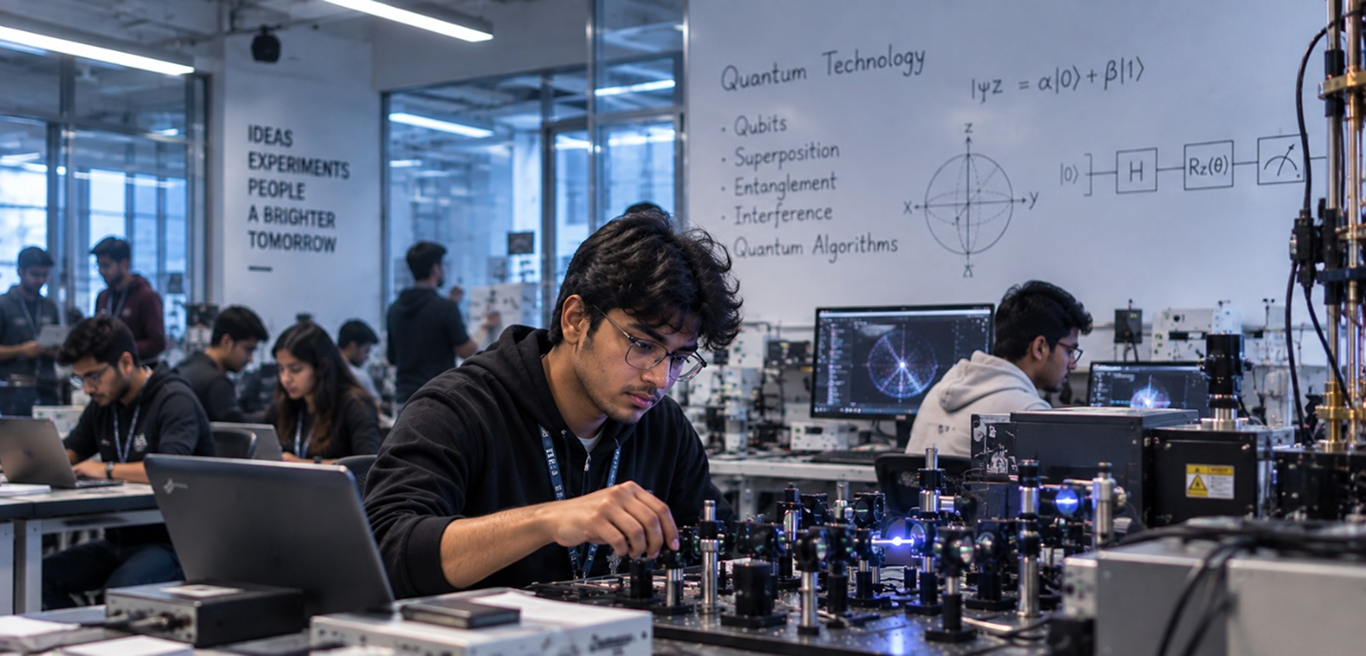
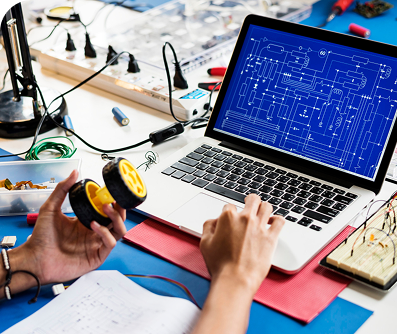
Yes. The program includes programming, optics and photonics, cryogenics, quantum hardware and cloud quantum computing labs, along with project-based learning every semester.
In Year 4, students choose one of three tracks: Quantum Computing & Quantum AI, Quantum Devices & Sensing, or Quantum Communication & Cryptography.
Yes. Students complete a summer internship in Year 3 and a research internship or lab rotation in Year 4, followed by a capstone project or research thesis.
Graduates can work as Quantum Software Engineers, Quantum Algorithm Researchers, Quantum Hardware Engineers, Quantum Cryptography Engineers, Quantum Sensing Scientists and Quantum ML Researchers, or start their own quantum ventures.
Yes. Graduates are well prepared for M.Tech, MS and PhD programs in quantum science and engineering at leading Indian and international universities.
Yes. The ATLAS career services team supports students with internships, industry connections and placement opportunities across the quantum and deep-tech ecosystem.
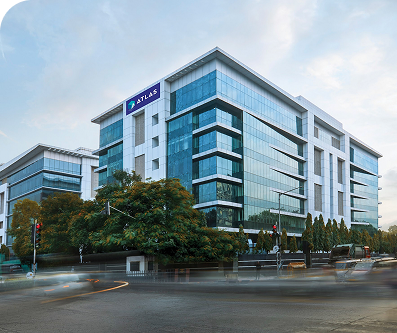
The campus is located at Equinox Business Park, Bandra-Kurla Complex (BKC), Kurla West, Mumbai, with modern classrooms, labs and collaborative learning spaces.
It is a 4-year, full-time program spread across 8 semesters.