


You have looked up the same phrase five times across three different tabs. Everyone around you seems to have picked a degree already. Some are going with BBA. A few are saying BBA Hons is better. Nobody is actually explaining why.
Here is what the choice actually changes: your first job title, your MBA eligibility, and whether a university in the UK or Canada will even consider your application without a bridging year. That is not a small gap. It is the kind of gap that shows up clearly at 22, when two people who graduated from the same campus are applying for the same role and one of them has a research project to talk about and the other does not.
The Indian higher-education landscape shifted significantly after NEP 2020 formalised the four-year undergraduate structure. Today, BBA Hons meaning is not simply "a longer BBA." It is a different academic product, with more credits, structured specialisation, and real implications for where you go next. This guide breaks that down clearly, so you know exactly what you are choosing and why it matters.
BBA Hons full form is Bachelor of Business Administration (Honours). The term "Honours" signals that the programme goes beyond a broad overview of business subjects and instead requires the student to demonstrate advanced competence in a chosen specialisation. If you have been asking what BBA Hons full form stands for in the context of NEP 2020, the answer is a four-year, 160-credit degree that is structurally different from a standard BBA.
Under UGC's National Higher Education Qualifications Framework, a BBA Hons degree is a Level 6 qualification completed over four years and eight semesters, accumulating 160 credits. A regular three-year BBA ends at 120 credits. That 40-credit gap is not filler. It maps to advanced coursework in the student's chosen specialisation, a research project or dissertation, and additional skill-based courses aligned to NEP 2020's multidisciplinary mandate.
BBA Hons means something specific on a degree certificate and a resume: the holder committed to depth, completed a research or applied project, and met a higher academic threshold than a standard BBA graduate. When parents ask what BBA Hons means in practical terms, the answer is a graduate who enters the workforce or an MBA programme with measurably more domain expertise than their general BBA counterpart. Recruiters and postgraduate admissions committees at both Indian and international universities are beginning to read this distinction clearly.
One additional point worth knowing: under NEP 2020's multiple entry-exit framework, a student enrolled in a four-year BBA Hons programme can exit after three years with a regular BBA degree if they choose not to continue. The Honours designation is earned only upon completing all four years and meeting the credit requirement. This flexibility means choosing the Honours programme is not a one-way door, but it does require a commitment to see it through.
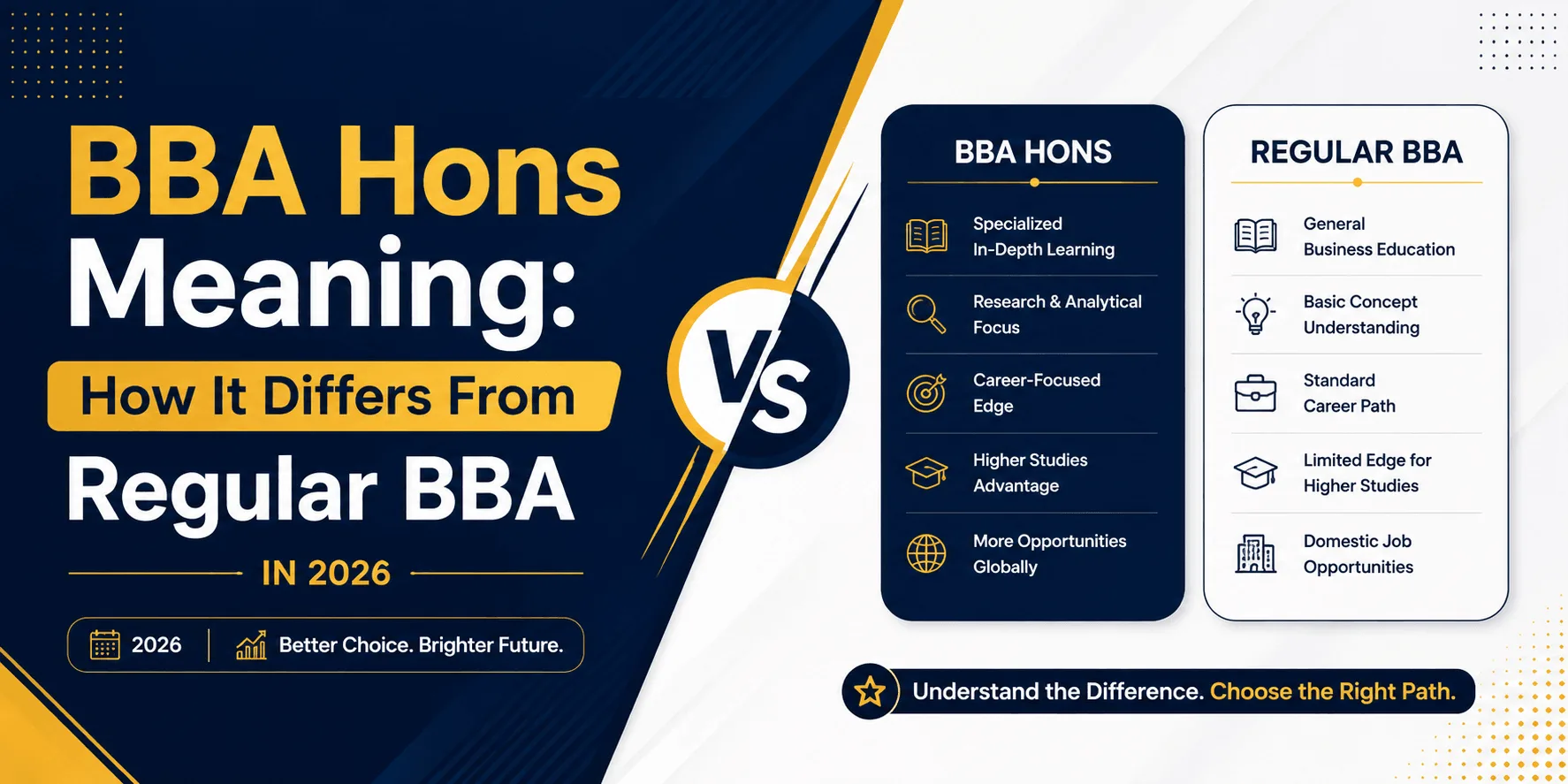
The difference between BBA and BBA Hons comes down to four variables: duration, credits, depth, and what the degree opens after graduation. Before getting into the variables, it is worth stating that BBA Hons meaning in a university prospectus and BBA Hons meaning in an employer's shortlisting criteria are increasingly the same thing: advanced specialisation, fourth-year research, and 160 credits.
A regular BBA is three years and six semesters, resulting in 120 credits. A BBA Hons runs four years and eight semesters, accumulating 160 credits. The fourth year is where the meaningful differentiation happens: advanced specialisation courses, a research component or industry project, and electives that go well beyond the general BBA curriculum.
A regular BBA builds a broad foundation across finance, marketing, operations, and human resources. BBA Hons assumes that foundation is in place by Year 2 and uses Years 3 and 4 to go significantly deeper into one or two domains. A student in BBA Hons finance and banking will study corporate valuation, financial derivatives, investment analysis, and treasury management to a level that a general BBA never reaches.
Many foreign universities, particularly in the UK, Canada, and Australia, require a four-year undergraduate degree for direct master's admission. A BBA Hons satisfies this requirement. A three-year BBA often requires an additional year of study or a bridging qualification before a student can apply to an overseas postgraduate programme.
Both degrees are accepted by Indian MBA programmes. However, BBA Hons often gives an edge in admissions interviews because the research project or dissertation demonstrates analytical rigour. Students targeting IIM, ISB, or overseas MBA programmes benefit from the signal the Honours degree sends.
BBA Hons typically have higher cut-offs than general BBA at the same institution. The academic demand is real, and universities set the bar accordingly.
BBA Hons subjects follow a clear progression across the four years, moving from foundational to advanced. The year-by-year breakdown below covers the standard BBA Hons subjects framework as adopted by most NEP 2020-aligned universities in India. Knowing the BBA Hons full form is one thing; understanding what the programme actually teaches across eight semesters is where the real decision gets made.
Financial Accounting, Business Mathematics, Principles of Management, Business Communication, Microeconomics, and Computer Applications. This year is broadly similar to the first year of a regular BBA.
Human Resource Management, Business Analytics, Cost and Management Accounting, Operations Management, Research Methods in Management, and Information Systems. The research methods course is often the first point where BBA Hons students begin to diverge from their general BBA peers. The analytical rigour goes up a notch.
Strategic Management, International Business, Business Law, Direct Taxes, GST and Indirect Taxation, and electives from the chosen specialisation. By this point, a BBA Hons student is spending roughly a third of their coursework inside their specialisation domain.
Advanced specialisation electives, a dissertation or research project, and applied industry modules. This is the year that earns the Honours designation. Students completing BBA Hons with a research dissertation become eligible, upon further study, for direct PhD admission under NEP 2020 guidelines.
The assessment structure across BBA Hons subjects typically includes semester examinations, internal assessment, project work, viva voce, and an internship. The internship, usually in Semester 5 or 6, is a significant practical exposure window that general BBA programmes also include but that carries heavier weight in an Honours curriculum given the research context that surrounds it.
One frequently asked question is whether BBA Honours finance subjects differ significantly from BBA Hons finance and banking subjects at the same level. The terminology varies by institution, but both refer to the same finance specialisation track within the Honours degree structure.
BBA Hons is where specialisation choice becomes career-shaping rather than elective-picking. When students research BBA Hons meaning in the context of career outcomes, the specialisation track is the variable that matters most. The four tracks with the strongest placement demand in 2026 are:
Covers corporate finance, investment banking fundamentals, treasury operations, financial risk management, and capital markets. BBA Hons finance and banking prepares students for analyst and associate roles at banks, NBFCs, and financial services firms. Students who want to go deeper into capital markets and derivatives often find that BBA Honours finance coursework at the fourth-year level rivals the first year of a finance MBA in content density. The difference between BBA and BBA Hons is especially sharp in this specialisation: a general BBA's finance elective covers concepts that BBA Honours finance treats as prerequisites. KPMG, Deloitte, and Accenture are among the recruiters actively hiring from well-placed BBA programmes with strong finance specialisations.
Covers data interpretation, statistical tools, business intelligence platforms, and applied analytics for decision-making. BBA Hons business analytics is increasingly sought after as companies across sectors build internal data teams. Students who combine analytics coursework with an industry project in Year 4 enter the job market with a tangible proof-of-work that general BBA graduates rarely have. If you are comparing BBA Hons business analytics to a general BBA with a data elective, the difference is roughly the same as comparing a minor to a major.
Covers performance marketing, SEO, social media strategy, content operations, and marketing analytics. BBA Hons in digital marketing suits students targeting the fast-moving media, e-commerce, and agency sectors. The specialisation pairs well with internships at digital-first companies where campaign results can be demonstrated numerically. Students pursuing BBA Hons in digital marketing should look for programmes that include live project components and access to real ad accounts, not just classroom simulations.
Also Read: BBA Digital Marketing Subjects, Tools and What the Course
A broader Honours track for students who want leadership-track roles or plan to build a venture. Strong on strategy, organisational behaviour, and business design subjects.
Other available specialisation tracks include Human Resource Management, International Business, and Supply Chain and Logistics. The BBA Hons specialisation you choose should map to your MBA goal and your three-year career target, not simply to what sounds prestigious in a prospectus.
The difference between BBA and BBA Hons shows up most clearly in the first two years after graduation. Understanding BBA Hons meaning from a career lens, rather than just an academic one, is how students make this decision well. General BBA graduates typically enter at executive or coordinator level in marketing, sales, operations, and HR. The roles are real and the learning is valuable, but they are entry-level by design.
BBA Hons graduates, particularly those from programmes with strong industry connections and placement infrastructure, have access to analyst-level and associate-level roles that carry more responsibility and meaningfully higher starting packages. A strong BBA programme, for context, is placing graduates at an average of ₹9–13 LPA at the MBA level, with BBA-level averages around ₹13 LPA at top institutions. The Honours route, with its deeper specialisation and research exposure, positions students closer to that upper band from Day 1 rather than having to earn their way there over two years of work experience.
For students targeting an MBA within three to five years of graduation, BBA Hons provides a cleaner entry narrative. The Honours project or dissertation is a concrete proof point during MBA admissions. At institutions that require a four-year degree, it removes a barrier that a standard BBA cannot.
For students considering study abroad, the BBA Hons degree satisfies the four-year requirement that many UK, Canadian, and Australian master's programmes impose. UBC, for example, has formalised partnerships with Indian institutions that include substantial scholarship support for qualifying students, with collaborative programmes that reward the academic depth the Honours degree signals.
In 2026, the career argument for BBA Hons rests on three pillars: deeper specialisation creates role-readiness faster; the research component signals analytical rigour to employers and MBA committees; and the four-year degree structure removes friction for international postgraduate admissions. The difference between BBA and BBA Hons is no longer just academic — it is a career positioning decision.
Choosing between a regular BBA and a BBA Hons is ultimately about deciding how much depth you want from your undergraduate years. A regular BBA can give you a strong foundation in business, while a BBA Hons takes that foundation further through advanced specialisation, research, and applied learning. The four-year structure can also give you greater flexibility if you plan to pursue an MBA, enter a specialised business role, or consider postgraduate study abroad.
But the degree title alone should not make the decision for you. Look closely at the curriculum, specialisations, industry exposure, internships, research opportunities, and the kind of learning environment the university provides. The right programme is one that matches not just your first job, but the kind of professional you want to become.
For students exploring a BBA Hons programme, ATLAS ISME offers an interdisciplinary approach to undergraduate business education, bringing together business, technology, design, entrepreneurship, and experiential learning. It is worth exploring the programme and its learning model to see how it fits with your interests and long-term career plans.
BBA Hons stands for Bachelor of Business Administration (Honours). It is a four-year undergraduate degree with advanced specialisation and a research or applied project.
BBA Hons indicates four years of study, 160 credits, advanced specialisation, and a research or applied project under the NEP 2020 framework.
The key difference between BBA and BBA Hons is duration, credits, and depth. A regular BBA is typically three years and 120 credits, while BBA Hons adds a fourth year with advanced specialisation and research.
BBA Hons subjects typically include management, accounting, economics, analytics, strategy, and specialisation-specific courses. The exact subjects vary by university and specialisation.
Yes, BBA Hons Finance and Banking can suit students interested in investment banking, corporate finance, treasury, and financial services. The curriculum provides deeper finance specialisation than a general BBA.
BBA Hons Business Analytics is a specialisation covering data analysis, statistics, business intelligence, and analytics for business decisions. It can prepare students for roles in analytics, consulting, and product operations.
Yes. BBA Hons in Digital Marketing covers areas such as performance marketing, SEO, content, social media, and marketing analytics, preparing students for both agency and brand-side roles.
Yes. BBA Hons graduates can apply to Indian MBA programmes and international postgraduate programmes that require a four-year undergraduate degree. The research component can also strengthen their applications.