



There's a question worth sitting with before any discussion of entrepreneurship in higher education begins: What does it actually mean to think like an entrepreneur?
Ask most people, and they'll point to the obvious markers. That is the funding round, the product launch, the LinkedIn headline that says "Founder." But that framing misses the point almost entirely. Some of the most entrepreneurially-minded people in the world have never started a company. And some people who have started three couldn't tell you why two of them failed.
The thinking comes first. Everything else follows. Understanding the real difference between entrepreneur and business is where this clarity begins. A business is a structure. An entrepreneur is a way of seeing, one that can exist just as powerfully inside an organisation as outside one. It isn't about rushing to register a company or pitching a half-formed idea to investors. It is about how a person reads a situation, whether they see a dead end or a detour worth taking. It's the instinct to ask why not? when everyone else has already accepted that's just how it is. It's the discomfort of sitting with an unsolved problem long enough to actually understand it, rather than reaching for the nearest available solution.
Every student entrepreneur who walks through these doors carries some version of that instinct. The role of structured entrepreneur education is not to implant it, it's to sharpen it. To give it language, context, and a safe enough space to be tested before the real world does the testing instead.
Because here's the truth that most institutions are still catching up to: entrepreneurial thinking isn't a subject you can schedule for a Tuesday afternoon. You cannot lecture someone into intellectual courage. You cannot assign readings on resilience and expect it to show up under pressure. You have to create the conditions for it to happen and then trust that when students are given the right environment, the right challenges, and the right people around them, the entrepreneur mindset develops on its own terms.
That's a harder thing to build than a curriculum. Which is exactly why it matters.
The world students are entering today is structurally different from the one that most curriculum frameworks were built for. Industries are being reshaped by AI, climate pressures, and geopolitical shifts at a pace that makes specific job-role predictions nearly impossible. What remains constant is the ability to navigate ambiguity with confidence.
This is why entrepreneurial thinking has moved from a nice to have to a core competency across disciplines. It's not the exclusive domain of people launching startups. A lawyer who can anticipate regulatory gaps before they become crises, a designer who understands the business model behind the experience they're creating, a technologist who can spot the human problem underneath a technical one, these are all expressions of the same foundational capability.
The critical shift in understanding, particularly for students entering university, is recognising the difference between entrepreneur and business. An entrepreneur is not defined by ownership of a company. They're defined by their orientation toward problems, their willingness to take initiative, absorb uncertainty, and create value in conditions that are rarely ideal. That mindset can live inside a corporation, a nonprofit, a government body, or yes, a startup. Clarifying this early changes how students relate to the learning itself.
Any institution can put innovation on a banner. What's harder and more meaningful is building a culture where a student entrepreneur genuinely feels safe to try something, have it not work, and use that experience to try smarter the next time.
At ATLAS, this is built into the fabric of campus life rather than bolted onto it. MVP showcases, Startup Saturdays, VC pitch competitions, venture labs, and makerspace access aren't extracurricular decorations. They are deliberate environments where entrepreneur business ideas get stress-tested in conditions that approximate the real world closely enough to matter, but safely enough to learn from.
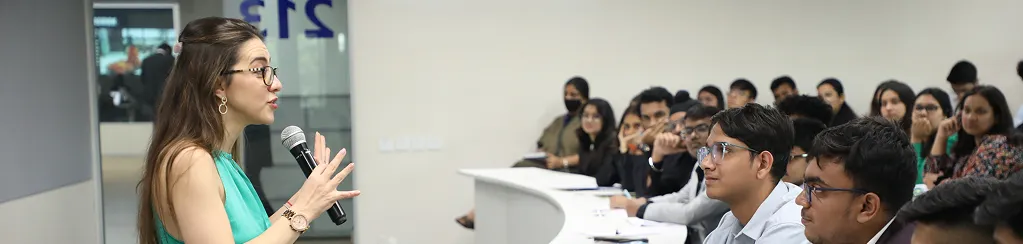
When a student pitches an idea and gets hard questions from a panel of industry practitioners, they're gaining entrepreneur experience that a case study simply cannot replicate. The discomfort of defending a position, the recalibration after critique, the revision that follows: this is where the mindset forms. Not in the preparation for the pitch, but in the live encounter with it.
There's also something important about the peer dimension here. When students see their classmates iterate, when they watch someone else take a knock, adjust, and come back stronger, they absorb a lesson about persistence that no lecture can convey. Shared entrepreneur experience across a cohort normalises the reality that the path is rarely linear.
Good intentions aren't enough. Without structure, experiential learning becomes activity for its own sake. What differentiates meaningful entrepreneur education from a collection of interesting events is intentional curriculum design, where theory, practice, and reflection are sequenced to reinforce each other.
The objectives of training in entrepreneurship at ATLAS are built around three interlinked outcomes: the development of problem-sensing ability, the confidence to act under uncertainty, and the ethical judgment to evaluate not just whether something can be done, but whether it should be. These aren't soft skills, they're the hardest skills to develop and the most consequential in any leadership role.
Entrepreneurship training that meets these objectives moves through several layers. Students begin by building frameworks, understanding how markets work, how value is created, where disruption typically originates. They then apply those frameworks in live contexts, whether through industry projects, client briefs, or their own venture attempts. And critically, they're guided to reflect on both, to surface what they assumed before they began and examine whether those assumptions held.
This loop — learn, apply, reflect, refine — is the engine of genuine entrepreneur education. It's also what distinguishes a rigorous program from an inspirational one. Inspiration fades. A well-practised reflective habit doesn't.
For students drawn to the intersection of business fundamentals and entrepreneurial application, BBA entrepreneurship as a structured academic pathway provides something that informal learning cannot: cumulative depth.
Across four years, students in ATLAS's ISME School of Management & Entrepreneurship don't just encounter entrepreneurship as a subject, they develop a relationship with it as a discipline. In the early years, this means understanding the mechanics: market analysis, business modelling, venture finance, legal frameworks. As they advance, the learning becomes more sophisticated, strategy under constraint, ethical leadership, scaling challenges, the psychology of decision-making.
What makes this compounding work is the integration with real entrepreneur experience throughout. Students at ISME engage with industry practitioners, participate in live consulting projects, and are consistently exposed to the kind of ambiguity that develops genuine judgment. By the time they graduate, the entrepreneur mindset isn't something they've been told to have, it's something they've actively practised.
The difference between entrepreneur and business also gets worked through at depth here. Students come to understand that business is a system; entrepreneurship is an orientation toward that system. This distinction becomes the foundation for thinking clearly about innovation inside organisations, not just around them.
Designing an entrepreneur mindset curriculum is harder than it looks. The temptation is to fill it with tools, lean canvas, design thinking workshops, pitch decks. And tools have their place. But a curriculum focused primarily on tools produces students who know the methods without understanding when and why to apply them.
A genuine entrepreneur mindset curriculum starts from character before it arrives at competence. It asks students to examine their relationship with uncertainty before it teaches them to manage it. It builds self-awareness as a prerequisite to strategy. It treats ethical reflection not as an add-on module, but as a thread woven through every decision-making framework introduced.
Faculty mentorship is indispensable here. Educators who draw on their own entrepreneur experience, who can say "I've been in a situation that looked like this, and here's what I learned", bring a texture to the teaching that case studies from distant industries rarely achieve. This is why ATLAS invests in faculty who have worked across sectors, not just researched them.
Peer learning extends this further. When a student entrepreneur at ATLAS engages in structured dialogue with peers from design, technology, and law backgrounds, they develop what might be called peripheral vision, the ability to see a problem from angles their own discipline wouldn't naturally illuminate. This cross-disciplinary exposure isn't incidental; it's essential to developing the entrepreneur mindset at its most useful.
There's a question prospective students and parents often ask: what does all this entrepreneurial training actually prepare you for, practically?
The answer is more varied than most expect. Yes, over 1,200 ATLAS alumni have launched startups. But the entrepreneur mindset that ATLAS cultivates travels into every professional path equally well. Alumni are leading innovation teams inside Fortune 500 companies, building policy frameworks in government roles, designing legal structures for emerging technologies, and creating social enterprises that address problems their institutions hadn't thought to address.
The common thread is a quality of thinking, the ability to identify what actually needs solving before committing to a solution, to hold complexity without becoming paralysed by it, and to bring others along through genuine conviction rather than forced consensus. These are the objectives of training in entrepreneurship made real in professional life.
What the campus experience provides is a window into this, a space to develop these capabilities when the stakes are formative rather than existential. Every VC pitch competition that doesn't go as planned, every MVP that the market responds to in unexpected ways, every moment of friction in a collaborative project, these are the training grounds. The entrepreneur business ideas that emerge from campus may not all survive contact with the market. But the thinkers who developed them, shaped by structured entrepreneurship training and genuine reflective practice, absolutely will.
Not every student at ATLAS will start a company. Not every student should. And honestly, that's never been the point. The point is what happens to a person when they spend three or four years in a place that refuses to let them coast. When someone they respect challenges an idea they were sure about. When something they worked hard on doesn't land the way they expected, and they have to sit with that, figure out why, and decide whether to go again. Those moments are uncomfortable. They're also the moments that actually change how a person thinks.
No lecture creates that. No textbook either. What stays with a graduate isn't the frameworks they memorised or the assignments they submitted. It's the version of themselves they had to become to get through the harder things. The confidence that comes not from being told you're capable, but from discovering it in a situation where it genuinely mattered.
That's what a real entrepreneur education builds. And that's what the entrepreneur mindset actually feels like from the inside, not a polished pitch, but a quiet knowing that you've been tested, you've grown, and you can do it again.
So if you're a student figuring out where to spend the next few years of your life, don't just ask which university looks good on paper. Ask which one will make you genuinely better at being you.
We think that's ATLAS. Come find out for yourself, explore our programs and see what's waiting for you on the other side.
1. How to inspire entrepreneurial thinking in your students?
Stop trying to teach it and start building the conditions for it. When students are given real problems, genuine stakes, and the freedom to fail without it being catastrophic, entrepreneurial thinking tends to emerge on its own. The educator's job isn't to install a mindset — it's to create an environment where that mindset has room to develop.
2. How to improve entrepreneurial thinking?
Practice it in situations that are actually uncomfortable. Entrepreneurial thinking sharpens when you're regularly asked to navigate ambiguity, make decisions without complete information, and reflect honestly on what went wrong. The more you do that and mean it the more natural it becomes.
3. What are the 5 C's of entrepreneurship?
Curiosity, Creativity, Confidence, Commitment, and Collaboration. Together they cover the full range of what entrepreneurship actually demands, the instinct to find the right problems, the imagination to approach them differently, the resilience to keep going, and the self-awareness to know you can't do it alone.
4. What are the 3 C's of entrepreneurial mindset?
Curiosity, Courage, and Consistency. Curiosity finds the problem worth solving, courage gets you moving despite the uncertainty, and consistency, probably the least glamorous of the three, is what actually separates people who build things from people who just talk about it.
5. What are the 5 factors that may promote entrepreneurship?
Quality education, strong mentorship, a culture that's genuinely okay with risk, access to real industry exposure, and a community of people who are also attempting hard things. The last one is more important than most people realise, the people around you shape what feels possible far more than any curriculum does.