
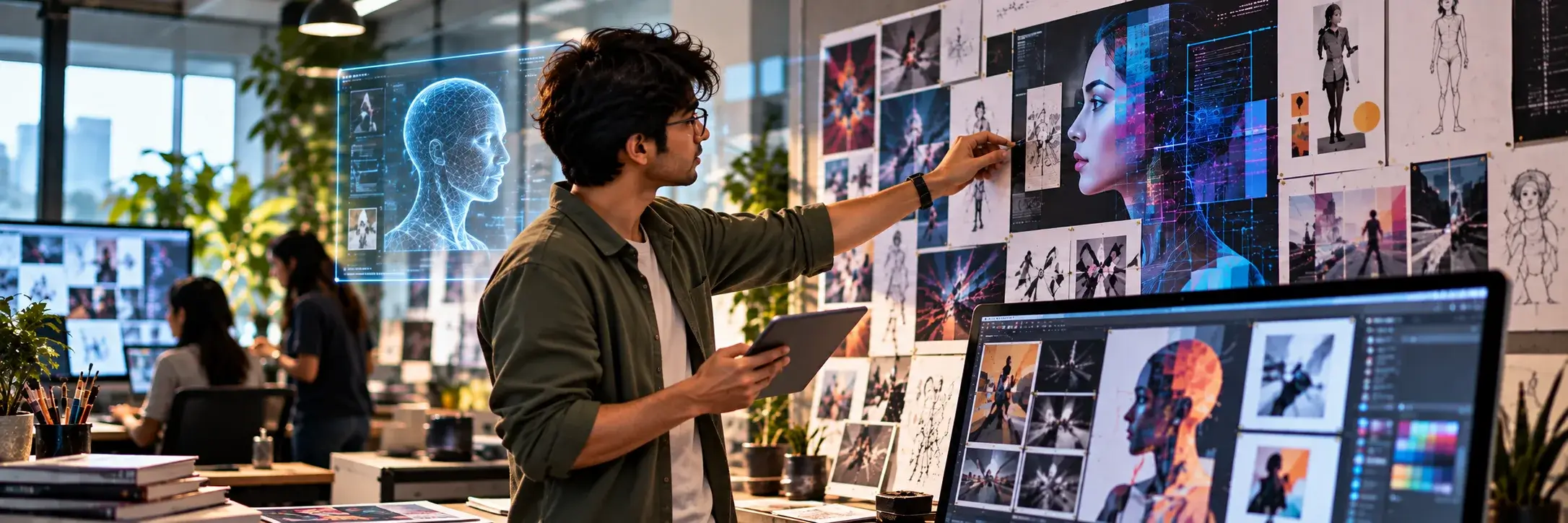

Communication design has always evolved alongside the technologies people use to create, share and consume information. From the introduction of digital publishing to the rise of smartphones and social media, every major technological shift has changed how designers approach visual storytelling, user engagement and information delivery. Today, artificial intelligence (AI) is accelerating this transformation, reshaping not only the tools designers use but also the way they think, experiment and solve problems.
AI can generate visual concepts in seconds, automate repetitive production tasks, analyse user behaviour and support the development of digital interfaces. However, these capabilities raise important questions about creativity, originality, accessibility and the role of human judgement in design.
For students exploring Bdes communication design as a career, understanding this shift is essential. The future of the discipline will depend on more than technical proficiency or familiarity with the latest software. Designers will need to combine visual literacy, critical thinking, technological fluency and an understanding of human behaviour to create meaningful communication experiences.
The real question, therefore, is not whether AI will change communication design. It is how designers can use these technologies responsibly while preserving the human insight that makes communication effective.
Also Read: Bdes Communication Design vs Graphic Design: Key Difference?
The growing capabilities of AI design tools are changing how designers develop brand identities, build digital interfaces and create motion-based content. Instead of treating branding, UI/UX and motion design as separate creative processes, designers can increasingly use AI to explore how visual elements, interactions and movement work together across different platforms. These tools can accelerate experimentation, simplify repetitive tasks and make early-stage prototyping more accessible.
However, their effectiveness depends on how well designers understand the underlying design principles, audience expectations and communication objectives. AI can generate multiple creative directions, but selecting the right one requires strategic thinking, visual judgement and an understanding of the context in which the design will be experienced.
AI is influencing these three areas of communication design in distinct ways:
For students pursuing a B.Des in Communication Design, understanding these applications is an opportunity to develop a more flexible and technology-aware creative practice. The objective is not simply to learn more AI design tools, but to understand when and why to use them. Strong design fundamentals, critical evaluation and human-centred thinking allow designers to move beyond generated outputs and create work that is purposeful, distinctive and effective. As AI continues to evolve, the ability to combine technological capability with creative judgement will remain a valuable advantage.
As AI design tools become more capable of generating visuals, suggesting layouts and automating repetitive tasks, questions about the future of creative work are becoming increasingly relevant. However, the real distinction lies in understanding which tasks AI can simplify and where human creativity, judgement and contextual understanding remain essential.
AI can streamline several time-consuming activities, allowing designers to focus more on creative thinking and problem-solving.
These capabilities improve efficiency, but the outputs still require human review for quality, accuracy and relevance.
Effective communication design requires more than visual production. It involves understanding people, interpreting context and making decisions that serve a clear purpose.
The most effective approach is to use AI as a creative assistant, not a substitute for design expertise. A designer might use AI to explore branding concepts or generate interface layouts, but strategic decisions and user testing determine which solutions work best.
For students pursuing a B.Des in Communication Design, learning AI design tools alongside visual fundamentals, research and critical thinking is essential. As automation takes over more routine tasks, the ability to evaluate ideas, understand audiences and create meaningful communication will become an increasingly valuable skill.
As technology reshapes the creative process, communication designers need to develop skills that extend beyond software proficiency and visual execution. Familiarity with AI design tools is becoming useful, but knowing how to use them effectively requires a strong understanding of design fundamentals, critical thinking and audience behaviour.
Designers must learn to evaluate AI-generated outputs, refine creative concepts and identify when automation adds value without compromising originality or quality. Equally important are skills in visual storytelling, user research, UI/UX design, accessibility and ethical decision-making, particularly as communication increasingly moves across digital platforms.
While AI tools for graphic design can accelerate production and experimentation, the ability to interpret a brief, understand cultural context and translate complex ideas into meaningful visual experiences remains essential. For students pursuing a B.Des in Communication Design or a BDes in Design, developing this combination of creative, analytical and technological capabilities can build the adaptability needed to navigate an evolving design industry.
As AI becomes more integrated into creative workflows, preparing for a design career requires a balance of foundational knowledge, technological adaptability and practical experience. For aspiring communication designers, the goal is not to master every emerging tool but to understand how technology can support creative problem-solving. Developing this mindset early can help students build a portfolio and skill set that remain relevant as the industry evolves.
A solid understanding of typography, colour theory, composition, visual hierarchy and storytelling provides the foundation for effective communication design. These principles help designers evaluate AI-generated outputs critically and refine them into purposeful visual solutions rather than relying on automated results.
Explore AI tools for graphic design, visual generation and UI/UX prototyping to understand their capabilities and limitations. Experimenting with different tools can help students identify where AI improves efficiency, where manual refinement is necessary and how technology can support their creative process.
A strong portfolio should demonstrate more than polished visuals. Document the brief, research, concept development, iterations and reasoning behind each project. When AI is involved, explain how its outputs were evaluated and refined to show independent thinking and creative ownership.
Working on real-world briefs, collaborative projects and challenges that combine design with technology or business helps students understand practical constraints. This experience develops the ability to communicate ideas, incorporate feedback and create solutions that address genuine audience needs.
AI capabilities and design workflows will continue to change. Following industry developments, seeking feedback from practitioners and regularly experimenting with new approaches can help designers adapt without becoming dependent on a particular platform or tool.
Ultimately, an AI-augmented design career requires more than technical familiarity. It calls for curiosity, critical thinking and the ability to combine emerging technologies with human insight to create communication that is relevant, accessible and meaningful.
Also Read: What Software Will You Learn in a Visual Communication
The evolution of AI is changing how communication design is imagined, developed and experienced. From accelerating visual exploration to enabling more adaptive digital experiences, these technologies are expanding the possibilities of creative work. Yet, the ability to communicate meaningfully still depends on human judgement, cultural understanding and the capacity to solve problems with purpose. For aspiring designers, the opportunity lies in combining strong design fundamentals with technological fluency, critical thinking and a willingness to keep learning.
This makes choosing the right learning environment an important part of preparing for the future. Design education that encourages experimentation, interdisciplinary thinking and practical application can help students develop the confidence to navigate an evolving industry. For those exploring a B.Des in Communication Design, ATLAS ISDI offers a starting point to understand how creative practice, technology and real-world problem-solving can come together in design education. As AI continues to reshape the discipline, the focus should remain on using technology thoughtfully to create work that is not just visually compelling, but also relevant, inclusive and meaningful.
AI is streamlining design workflows through automated production, visual generation, rapid prototyping and personalised digital experiences, allowing designers to focus more on strategy and creative problem-solving.
AI is more likely to transform design roles than replace designers entirely. Human creativity, strategic thinking, cultural awareness and empathy remain essential for effective communication.
Students can explore AI-powered tools for graphic design, image generation, UI/UX prototyping, motion graphics and visual editing while strengthening their design fundamentals.
The discipline increasingly incorporates digital tools, interactive media, AI-assisted workflows and emerging technologies alongside visual storytelling, research, design thinking and ethical practices.
Empathy, contextual understanding, ethical judgement, strategic thinking and the ability to develop meaningful creative concepts remain critical, even as AI automates more design tasks.