Gaming is no longer confined to consoles, computers or mobile screens. It has grown into a significant part of the global entertainment and technology economy, influencing everything from digital storytelling and animation to artificial intelligence, immersive experiences and interactive media. With advancements in graphics processing, real-time rendering, cloud technology and game engines, the possibilities of what a game can offer have expanded considerably.
The industry has also evolved beyond simply creating games for entertainment. Gaming technologies are now being explored in education, healthcare, defence training, simulation, virtual production and other sectors. This growing intersection of technology and creativity has opened up diverse opportunities for professionals with skills in design, programming, animation and digital production.
But creating a successful game is rarely the work of one individual or discipline. It involves a collaborative process where game designers conceptualise the experience, developers build its technical foundation, animators bring characters and environments to life, and artists, sound designers and writers contribute to the world players interact with. Each discipline has a distinct role, yet all work towards a shared creative vision.
This growing complexity has also made specialised skills increasingly important. Students exploring career opportunities in the gaming industry often come across two closely connected fields: game design and game development. While they work together, they differ in their approach, responsibilities and required expertise.
Understanding game design vs game development can help aspiring professionals identify where their interests lie and which learning pathway may suit their ambitions. Whether someone is drawn towards creative storytelling, gameplay mechanics, visual worldbuilding or programming interactive systems, both disciplines offer opportunities to contribute to an industry shaped by continuous technological change.
Let's understand how these two fields differ, how they collaborate, and what students should know before exploring game developer courses and career opportunities in India.
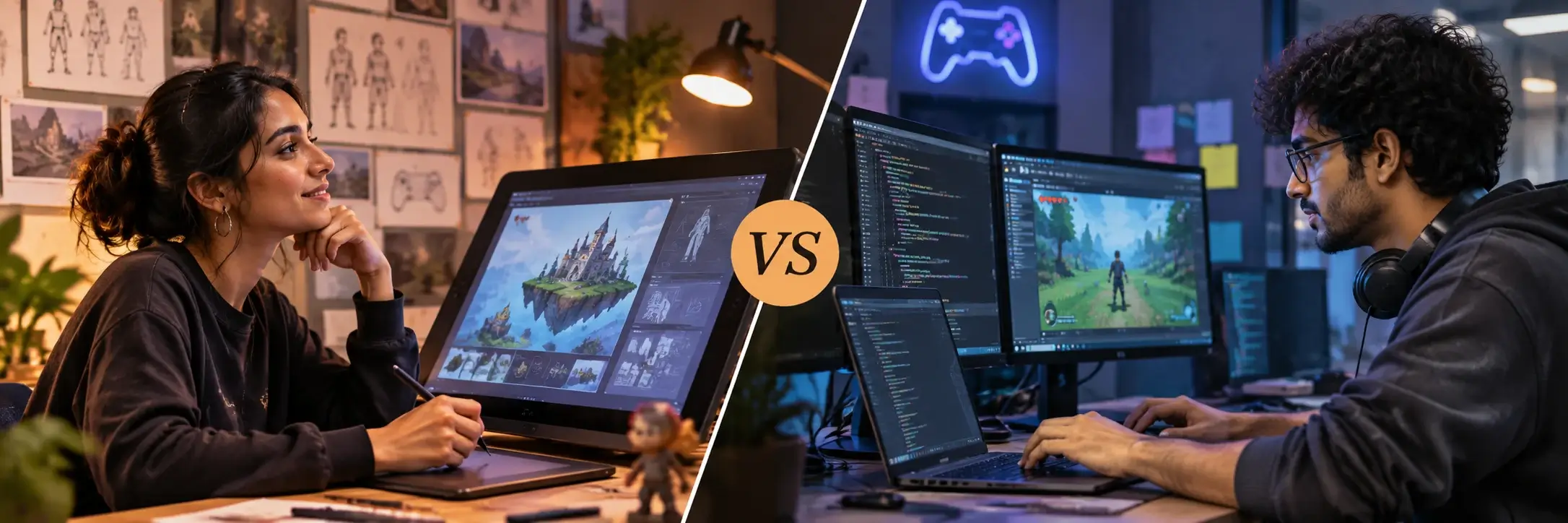
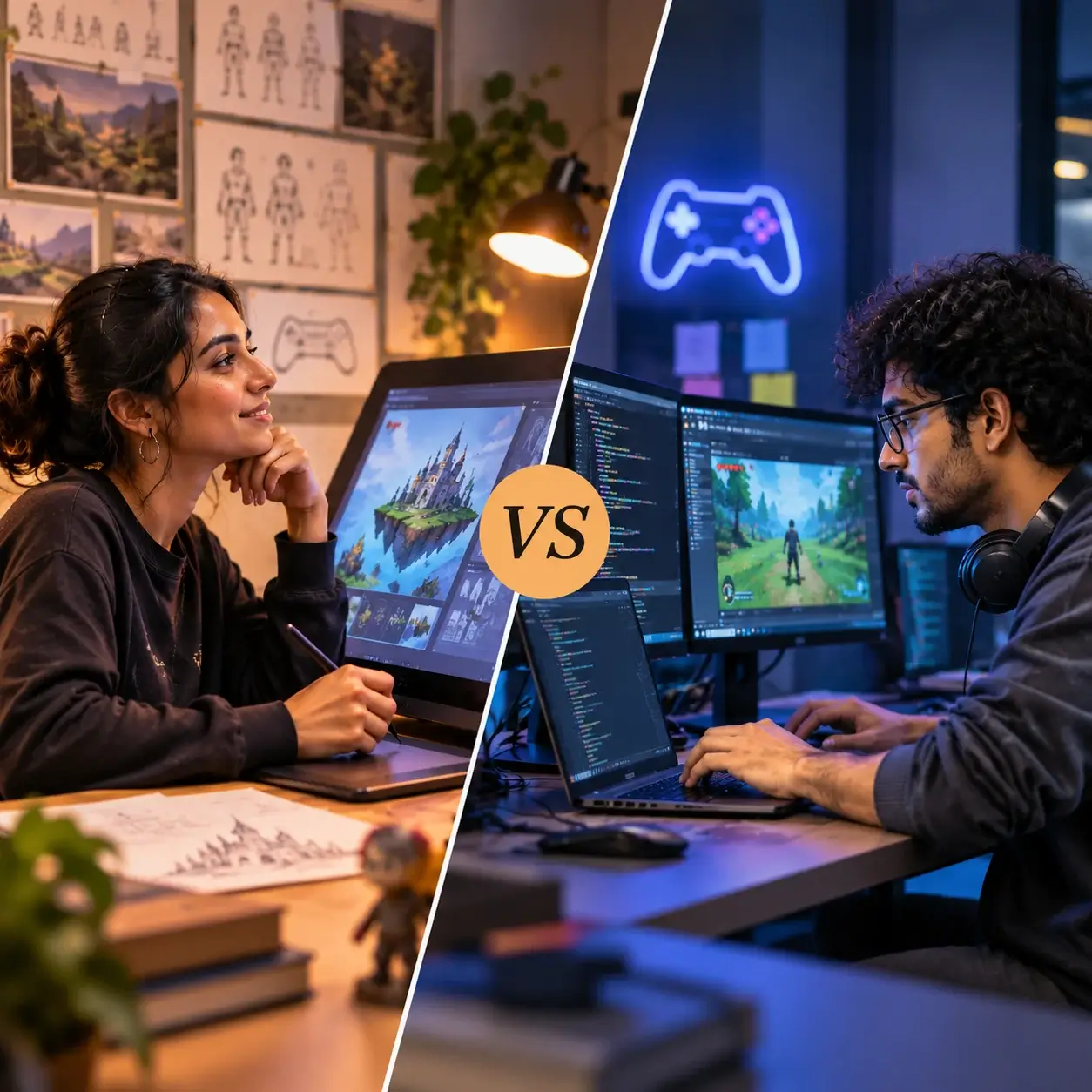
Game design and game development are two interconnected disciplines involved in creating a video game. While both aim to deliver an engaging player experience, their responsibilities differ. Game design focuses on the creative aspects, including concepts, storylines, characters and gameplay mechanics. Game development involves the technical processes that turn these ideas into a functional game. Understanding game design vs game development can help students identify which career path aligns with their interests.
Game design involves conceptualising and structuring a game's overall experience. Designers establish the concept, genre, theme and target audience while developing storylines, characters and fictional worlds that give the game its identity. They also define gameplay mechanics, rules, challenges and level structures to make the experience engaging and balanced.
Another important aspect is understanding player behaviour and experience. Designers work on intuitive interfaces, accessibility and progression systems to keep players engaged. They also create prototypes and conduct playtesting to identify gaps and refine gameplay. Students exploring a BSc Animation and Game Design or Bachelor of Arts Animation and Game Design can develop an understanding of these creative principles alongside animation and interactive storytelling.
Also Read: B Des in Animation & VFX: Is Game Design the Career No One Knows ?
Game development focuses on translating a game's concept into a playable digital experience through programming and technical implementation. Developers write code for character movement, player controls, interactions and gameplay functions. They also use game engines such as Unity and Unreal Engine to build environments, integrate visual assets and connect different game components.
The process also involves developing physics systems, artificial intelligence (AI) for non-player characters (NPCs), graphics rendering and performance optimization. Developers test and debug the game to ensure it functions smoothly across platforms. Students exploring how to become a game developer can start by learning programming languages, understanding game engines and building practical projects. Specialised game developer courses can provide structured technical training, while an animation and VFX course or BDes in Animation can help students interested in the visual and creative aspects of game production.
While game design and game development work towards creating the same final product, their roles differ in terms of responsibilities, skills and creative approaches. Understanding these differences can help students decide which discipline aligns better with their interests and career goals.
Game design focuses on shaping the player's experience through concepts, storylines, characters, gameplay mechanics and level progression. Game development focuses on bringing these elements to life through programming, interactive systems and technical implementation. While designers decide how a feature should work, developers build the systems that make it possible.
Game designers rely on creative thinking, storytelling, visualisation and an understanding of player behaviour. Game developers require technical and analytical skills, including programming, mathematics, physics and software development. Both professions, however, involve problem-solving and collaboration, making an understanding of the other discipline equally valuable.
Game designers use tools such as Figma, Miro, Unity and Unreal Engine to visualise concepts and prototype experiences. Developers use game engines, Visual Studio and Git to write code, integrate assets and build gameplay systems. Familiarity with these technologies is an important part of industry-oriented game developer courses and game design programmes.
Game design offers roles such as Game Designer, Level Designer, Narrative Designer, Systems Designer and Game UX Designer. Game development opens pathways to careers such as Gameplay Programmer, Game Developer, AI Programmer, Graphics Programmer and Game Engine Developer. Both fields offer opportunities across gaming studios, interactive media, animation and immersive technology.
Game design and development depend on continuous collaboration. For example, while a designer establishes the gameplay mechanics and racing environment for a multiplayer game, developers build the vehicle physics, controls and multiplayer systems. Artists and animators contribute the visual elements, bringing the experience together. This collaborative approach makes gaming an exciting field for students from both creative and technical backgrounds, including those pursuing a BDes in Animation or BSc Animation and Game Design.
Building a career in the gaming industry requires a mix of creative thinking, technical knowledge and practical experience. Whether students are interested in game design or exploring game developer jobs, they need to understand the skills and tools involved in creating interactive experiences. Some important capabilities include:
Some commonly used tools across these disciplines include Unity, Unreal Engine, Blender, Visual Studio, Figma and Git. These support everything from visual asset creation and prototyping to programming and game testing.
Depending on their interests and specialisation, students can explore career opportunities such as:
The game developer salary in India varies based on experience, specialisation, portfolio and employer. For students exploring how to become a game developer, building technical proficiency and working on practical projects are important starting points. Those inclined towards the creative side can explore game design, animation and visual development pathways.
Also Read: 3D Animation Jobs in India 2026: BA in Animation Scope,
The future of game design and game development will be shaped by technological advancements that are changing how interactive experiences are created, delivered and consumed. Developments in artificial intelligence, virtual reality, augmented reality and real-time rendering are expanding the possibilities of gaming beyond conventional entertainment. Some of the key developments influencing the industry include:
These developments are also extending gaming technologies into sectors such as education, healthcare, architecture and simulation, creating opportunities beyond traditional game studios. As a result, future professionals will need to develop skills that connect creative thinking with technical understanding.
For aspiring designers and developers, this means focusing on more than just software proficiency. Some important areas to explore include:
As the gaming industry continues to evolve, professionals who can combine creative problem-solving with technological expertise will find opportunities across an expanding range of fields. Students considering a BSc Animation and Game Design, Bachelor of Arts Animation and Game Design or BDes in Animation should look for programmes that encourage experimentation and practical learning. Similarly, those exploring game developer courses should focus on building relevant technical skills alongside an understanding of the wider creative process. Ultimately, the future belongs to professionals who can bring ideas, technology and meaningful player experiences together.
Game design and game development are two sides of the same creative process. While one shapes the experience players interact with, the other builds the technology that makes it possible. As gaming continues to evolve, the distinction between creative and technical roles is becoming more fluid, making collaboration and interdisciplinary skills increasingly valuable.
For students considering a career in this industry, the starting point is understanding where their interests lie while remaining open to learning beyond one specialisation. Whether it is storytelling, animation, visual design or programming, the ability to connect different skills can make a significant difference in a rapidly changing industry.
An academic environment that encourages experimentation, practical projects and exposure to emerging technologies can help build this foundation. At ISDI, ATLAS SkillTech University, exploring design through the lens of animation, VFX and gaming offers students an opportunity to understand how creative ideas translate into digital experiences. For those interested in this intersection of art, design and technology, exploring the programme can be a useful next step in understanding the possibilities ahead.
Game design focuses on concepts, storylines, gameplay mechanics and player experiences, while game development involves programming and building the technical systems that make a game functional.
The programme combines creative and technical aspects of digital production, including animation, visual effects and gaming. The depth of game design and development exposure depends on the curriculum and practical projects.
Game development can offer higher earning potential in specialised roles such as AI and graphics programming. However, the game developer salary in India and game design salaries depend on experience, expertise, portfolio and employer.
Game developers generally need programming knowledge, particularly C# and C++. Game designers do not necessarily need advanced coding skills, but understanding basic programming and game engines is beneficial.
Game design may be a better fit if you enjoy storytelling, character creation, worldbuilding and gameplay concepts. You can also explore a BDes in Animation or an animation and VFX course to develop creative skills relevant to game production.