
If you have ever wondered why one room feels welcoming while another feels uncomfortable, why people naturally gather in one part of a café, or why the layout of a store can influence what you notice and where you walk, you have already encountered the questions that sit at the heart of interior design. A well-designed space does more than look good. It shapes movement, behaviour, comfort, productivity, accessibility, and even the way people feel. This is why interior design today is far removed from the narrow idea of decorating homes or selecting furniture and colours. Designers work with space, materials, technology, sustainability, culture, and human behaviour to solve real problems through the environments they create.
For students completing Class 12, this makes interior design an increasingly interesting career to explore, but also one that deserves a more thoughtful approach. Choosing this field is not simply about having a creative eye or learning design software. It involves developing the ability to observe people, understand context, research problems, test ideas, work within constraints, and turn a concept into a space that can actually be built and experienced.
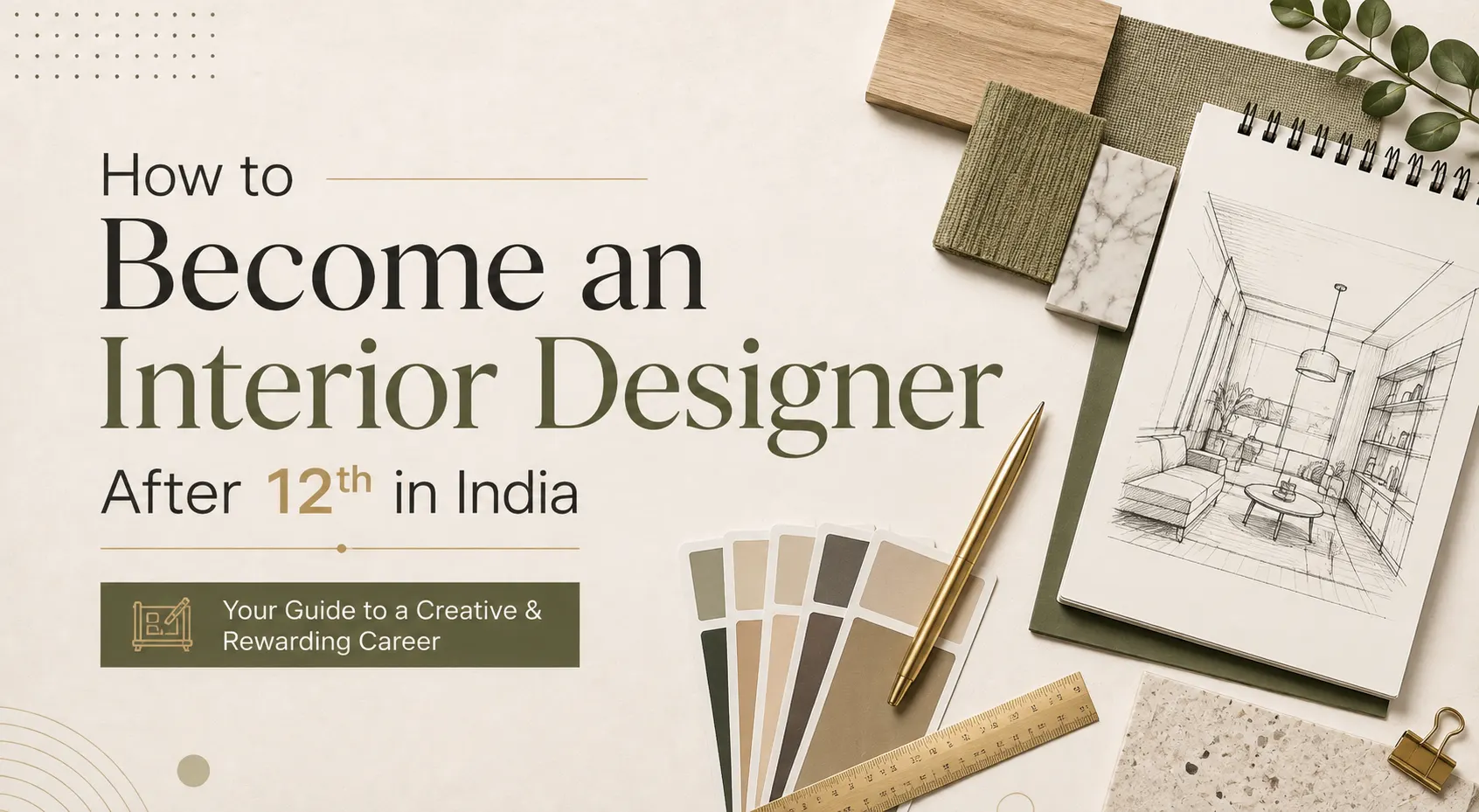
So, if you are exploring how to become an interior designer after 12th, the first step is to understand what the profession really demands and what kind of education can prepare you for it. From choosing the right programme and building a strong foundation in design to gaining industry exposure and developing a portfolio, the journey is as much about learning to think like a designer as it is about learning to design.
For students completing Class 12, the path into interior design is not limited to enrolling in a course and learning how to create visually appealing spaces. A strong foundation involves understanding design principles, developing technical and visual skills, working on projects, and gradually learning how design decisions respond to real people and real constraints. The right undergraduate programme can provide this foundation through a combination of studio learning, design theory, digital tools, material exploration, and practical exposure. If you are researching how to become an interior designer in India, it helps to think of the journey as a progression from learning the fundamentals to applying them in increasingly complex situations.
A typical pathway can include:
The important distinction is that becoming an interior designer is not a linear process where education ends with a degree. The best designers continue learning as materials, technologies, user expectations, and the built environment change. Your undergraduate education should therefore give you both the technical foundation to practise and the curiosity to keep questioning how spaces can work better.
Also Read: B Des Interior Design vs BSc: Which Interior Design Degree Gets You Hired Faster?
Once you understand the pathway into interior design, the next question is where and how you should study it. With several interior design schools and programmes to choose from, students often focus on the course title, reputation, or facilities. These matter, but they do not tell you what your actual learning experience will be like. A good programme should help you develop design judgement, technical skills, creative confidence, and the ability to respond to real-world problems. Before choosing an interior design degree, look closely at what and how you will learn.
A well-rounded curriculum should go beyond drawing and decoration. It should introduce you to spatial planning, materials, construction, lighting, furniture, digital tools, sustainability, and design research. This gives you the foundation to understand both the creative and technical sides of the profession.
Interior design is a discipline where ideas become stronger through experimentation and critique. Studio projects allow students to research a problem, develop concepts, test different approaches, and refine their solutions. This process helps build the design thinking that cannot be developed through theory alone.
Professional projects involve clients, budgets, timelines, contractors, materials, and site conditions that classroom exercises cannot always replicate. Internships, live briefs, site visits, workshops, and industry mentorship can give students a clearer understanding of how design works in practice. This exposure can also help students make more informed career decisions.
The spaces we use are influenced by technology, business, culture, psychology, sustainability, and changing consumer behaviour. An interior design program that allows students to engage with other disciplines can help them see these connections. This becomes particularly valuable as the role of designers expands beyond conventional interiors.
Good design education depends heavily on the quality of conversations around your work. Faculty should challenge your assumptions, ask the right questions, and help you understand why a solution works or does not. Regular critique and mentorship can gradually help students develop an independent design perspective.
For students comparing a bachelor of interior design with a B.Des interior design pathway, the title of the qualification is only one part of the decision. The more important question is whether the programme gives you the environment, exposure, and intellectual foundation to grow into a capable designer.
Choosing interior design after Class 12 is not simply about learning how to make spaces look better. It is about learning to understand how spaces work, how people experience them, and how design can respond to changing social, technological, environmental, and cultural needs. The right education can give you the technical foundation to work with materials, space, and technology, while studio projects, industry exposure, and interdisciplinary learning can help you develop the judgement needed to solve real design problems.
For students exploring how to become an interior designer after 12th, the most important decision is therefore not just choosing a degree. It is choosing a learning environment that encourages curiosity, experimentation, critical thinking, and real-world application. As the role of interior designers in India continues to evolve, these qualities can help you build a career that goes beyond conventional interior practice.
At ISDI, School of Design and Innovation at ATLAS SkillTech University, students learn through a design-led, interdisciplinary approach that connects creative practice with technology, business, and industry. If you are ready to explore design as a way of thinking, making, and solving problems, discover the undergraduate design programmes at ISDI and take the first step towards building your future in design.
Yes, students from different streams can pursue interior design after Class 12, depending on the eligibility criteria of the institution. Your stream does not determine your ability to become a designer. Creativity, spatial thinking, observation, and problem-solving are equally important.
A B.Des generally focuses on design thinking, creative problem-solving, studio practice, and interdisciplinary learning. A BSc in Interior Design typically has a stronger focus on the technical and applied aspects of interiors. The right choice depends on your career goals and preferred learning approach.
A bachelor's degree in interior design or a related design discipline typically takes three to four years, depending on the programme. The duration can vary across institutions and qualifications. Diplomas and certificate courses are generally shorter.
Interior designers commonly use software such as AutoCAD, SketchUp, Revit, 3ds Max, Rhino, and Adobe Creative Cloud tools. The exact combination depends on the designer's role and project requirements. Increasingly, designers are also exploring AI-powered tools for ideation and visualisation.
The scope of interior design in India continues to expand across residential, hospitality, retail, workplace, healthcare, and experience-led spaces. Technology, sustainability, and changing urban lifestyles are also creating new areas of practice. Designers can pursue studio careers, specialised roles, consulting, freelancing, or independent practice.