


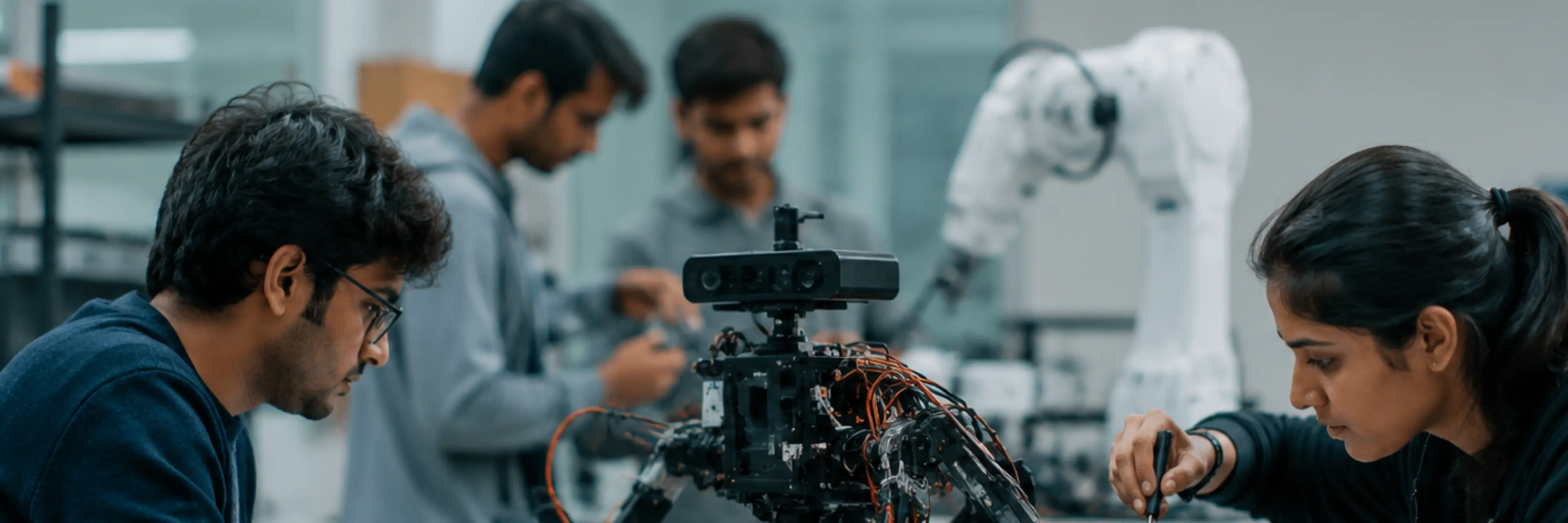
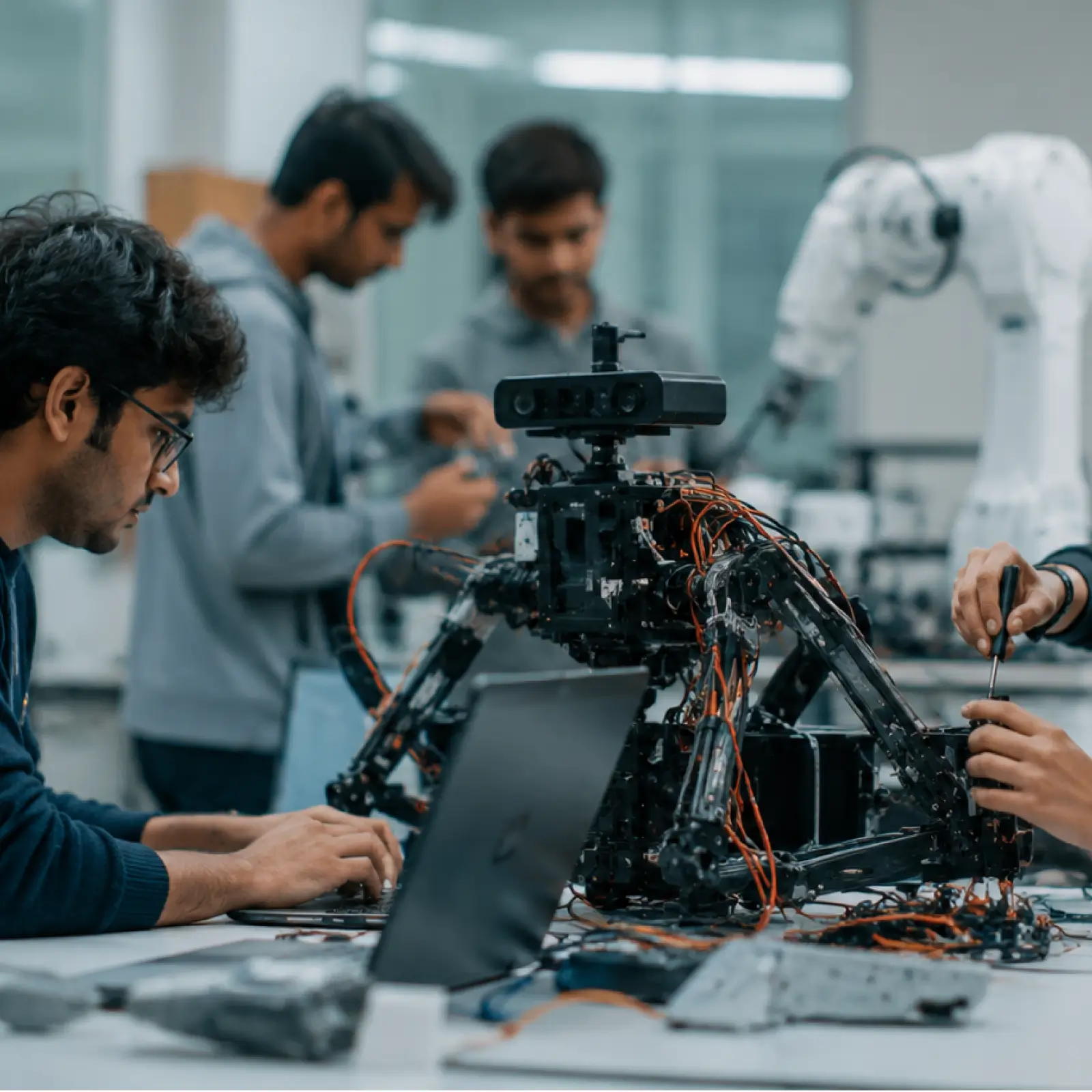
Btech in Robotics is no longer something that lives only in labs or sci-fi conversations. It is already embedded in everyday systems, quietly shaping how goods are delivered, how factories operate, and how complex tasks are handled in healthcare and logistics.
What has changed in recent years is scale. Automation is no longer experimental. It is operational and expanding fast. This is why robotics companies in India are growing across manufacturing, logistics, healthcare, agriculture, and defense, building solutions that are practical, scalable, and deeply relevant to real-world constraints.
For students pursuing a BTech in Robotics or a BTech in Robotics and Artificial Intelligence , this shift is important. You are not preparing for a future possibility. You are preparing for a present reality that is already evolving while you learn.
And that changes how robotics should be understood as a field.
A BTech in Robotics and Automation is not about learning isolated subjects. It is about understanding how mechanical systems, electronics, coding, data, and intelligence come together to create something that can act in the real world.
That is also why students often ask, is robotics engineering a good career? The answer depends on how comfortable you are working across disciplines. The demand is real, especially across robotics engineer jobs , but so is the expectation for applied, systems-level thinking.
At institutions like ATLAS SkillTech University, this interdisciplinary approach is central. Robotics is taught not as a narrow technical stream but as a convergence of design, technology, entrepreneurship, and real-world problem solving.
Robotics has shifted in a very practical way, even if it is not always visible on the surface. Earlier, automation meant fixed machines designed for repetitive tasks in controlled environments. Today, it is moving toward adaptive systems that can respond to changing inputs, environments, and real-time conditions. A warehouse robot, for instance, is no longer just following a set path. It is continuously interpreting data, adjusting movement, and coordinating with other systems as it works.
This change has also redefined what robotics systems look like. Instead of standalone machines, industries are building connected ecosystems where robots, sensors, software, and data systems work together. A manufacturing line today is less about isolated automation and more about a network of intelligent components exchanging information constantly.
As a result, the skill expectations have expanded. The role of a robotics engineer is no longer limited to hardware. It now sits across programming, control systems, AI integration, and real-world deployment challenges. This is also reflected in how robotics companies in India are hiring, with a clear preference for engineers who can think in systems rather than single functions, and who understand how mechanical, software, and data layers come together in practice.
A career in robotics doesn't follow a straight, predictable ladder anymore. It evolves as industries evolve. What you start doing in your first role can look very different from where you land a few years later, especially in a field as fast-moving as robotics and automation.
Instead of thinking in terms of fixed job titles, it helps to think in terms of the kind of professional you become over time:
Someone who understands how different parts of a machine, software, and environment interact, not just how a single component works.
A role that goes beyond coding or design. It involves shaping how entire automated systems are structured and how they function together.
An engineer working at the intersection of robotics and intelligence, where machines don't just move but also perceive and respond.
Focused on how people work alongside robots, making systems safer, more intuitive, and more usable in real environments.
When you look at robotics engineer jobs through this lens, they are less about fixed responsibilities and more about evolving capabilities. The same role can grow significantly as exposure increases and systems become more complex.
What really shapes long-term growth in this field is not early specialization, but adaptability. Robotics engineers who stay relevant are the ones who can move between hardware, software, and systems thinking without getting locked into just one layer.
In many ways, robotics doesn't reward narrow expertise as much as it rewards the ability to connect dots across disciplines and improve how entire systems behave over time.
Also Read: BTech Robotics and Automation: Future of Engineering or Niche
Robotics education is undergoing a quiet but important shift. The traditional approach of treating engineering as separate silos—mechanical, electronics, computer science—doesn't fully match how robotics works in the real world anymore. A robot is never just a mechanical system or just a software problem. It is a blend of both, along with data, control systems, and often even elements of design thinking and human behaviour. Because of this, learning robotics in isolation limits how well students can understand real-world systems.
A modern BTech robotics and automation program needs to reflect this complexity. Students benefit more when they are exposed to interdisciplinary learning models where they are not just solving theoretical problems, but working with real constraints like cost, usability, scalability, and performance. Robotics today sits at the intersection of multiple domains, which means the learning experience also needs to move beyond textbooks and into application-driven environments.
This is where institutions like ATLAS SkillTech University reflect a changing direction in higher education. The focus is not just on teaching concepts, but on helping students engage with real problems through industry-linked projects and hands-on learning. By integrating design, technology, and entrepreneurship into the learning process, students begin to understand how robotics systems are actually built, tested, and deployed in real environments, not just how they function in theory.
There is often a clear gap between what robotics students learn in classrooms and what they are expected to do in real-world roles. On paper, most graduates from a BTech in Robotics or related programs have a strong foundation in theory. They understand concepts like mechanics, control systems, programming, and basic automation. But when they step into industry environments, the expectations shift in a very different direction.
One of the biggest gaps is the lack of system thinking. Students are often trained to solve isolated problems, but robotics in practice is never isolated. It is a connected system where hardware, software, sensors, and data all influence each other. Without this systems view, it becomes difficult to understand how a change in one part affects the entire setup.
Another common gap is coding knowledge without deployment understanding. Many students can write algorithms or simulate solutions, but real-world robotics involves constraints like latency, hardware limitations, environmental noise, and safety considerations. What works in simulation often behaves differently when deployed in physical systems.
There is also a gap in integrating mechanical knowledge with AI and software systems. Students may understand individual domains, but struggle to bring them together into a functioning, intelligent system. Modern robotics requires this integration as a core skill, not an advanced add-on.
Because of these gaps, companies hiring for robotics engineer jobs are increasingly looking beyond academic performance. They want graduates who can operate in real-world complexity, not just theoretical clarity.
In short, the industry is not just looking for knowledge anymore. It is looking for applied understanding. The ability to connect concepts, test them in reality, and refine them based on how systems actually behave is what sets strong robotics professionals apart today.
Robotics engineering is not really a "stable vs unstable" career choice anymore. It is better understood as a "static vs evolving" field. The real difference in outcomes comes down to how interdisciplinary a student is willing to become. As automation expands across industries and robotics companies in India continue to grow, the demand is less about narrow specialists and more about engineers who can work across systems and adapt to AI-integrated environments.
This is also why the question of which engineering branch is best for the future doesn't have a single answer anymore. Future-ready fields are not defined by hierarchy, but by convergence. Robotics is a strong example of this shift because it naturally brings together computer science, mechanical engineering, electronics, and data-driven intelligence. It doesn't compete with these domains so much as it absorbs them. In that sense, the strongest advantage is not the branch itself, but whether it trains you to think in systems. Robotics sits exactly in that space.
Also Read : BTech in Robotics in India 2026: Industries, Companies and Why They're Growing
Robotics is no longer a distant or specialized career path. It is becoming a shared foundation across industries that rely on automation, intelligence, and precision. From manufacturing and logistics to healthcare and emerging deep-tech applications, the scope of robotics continues to expand in ways that are practical, not theoretical. For students pursuing a BTech in Robotics or a related specialization, this means the focus is no longer just on learning concepts, but on building the ability to work across systems, adapt to real-world constraints, and understand how different technologies come together in practice.
As the field evolves, so do the expectations. Success in robotics is less about mastering a single domain and more about developing fluency across mechanical systems, software, data, and artificial intelligence. This interdisciplinary approach is what truly prepares students for the complexity of modern robotics engineer jobs and the rapidly growing ecosystem of robotics companies in India .
For students looking to take the next step toward future-ready engineering education, ATLAS SkillTech University's UGDX program offers an industry-aligned, interdisciplinary learning experience designed to build this exact kind of mindset. It focuses on real-world application, cross-domain learning, and exposure to emerging technologies that shape tomorrow's careers.
There is no single "best" robotics company in India because the industry spans multiple areas like industrial automation, logistics, healthcare, and AI robotics. Some leading names include: GreyOrange – warehouse and logistics automation; Systemantics – industrial and collaborative robots; Genrobotics – sanitation and social impact robotics; Hi-Tech Robotics Systemz – autonomous systems and defense tech; Addverb Technologies – large-scale warehouse automation. The right choice depends on the domain you want to work in.
Key robotics and automation companies in India include: GreyOrange, Addverb Technologies, Systemantics, Genrobotics, Hi-Tech Robotics Systemz, Asimov Robotics, Invento Robotics, Gridbots, ABB India (Robotics), and KUKA Robotics India. These companies are shaping growth across manufacturing, logistics, healthcare, and AI-driven automation in India.
AI will mainly replace repetitive and rule-based tasks, not entire careers. Most affected areas include: Data entry and basic admin work; Routine accounting tasks; Basic customer support roles; Simple reporting and analysis work; Repetitive inspection in manufacturing. At the same time, fields like robotics, AI, and automation are growing because they build and manage these systems. The shift is about tasks changing, not jobs disappearing completely.